TLDR
If you are asking “is semaglutide a peptide,” the direct answer is yes. Semaglutide is a modified peptide medicine designed to act like glucagon-like peptide-1, or GLP-1. More precisely, it is a GLP-1 analogue and GLP-1 receptor agonist. It is similar to the natural hormone but engineered to resist rapid breakdown and remain active much longer. That classification helps explain its receptor target and molecular design, but it does not by itself establish effectiveness, safety, or suitability for any individual.
Semaglutide is not insulin, a steroid, or an exact copy of naturally occurring GLP-1. It has a peptide backbone produced using yeast fermentation and structural modifications that change how the molecule behaves in the body. The prescribing information describes it as having 94% sequence homology with human GLP-1. In plain English, its amino acid sequence is very similar—but not identical—to that of the natural hormone.
Why semaglutide is classified as a peptide
Peptides are chains of amino acids, the same molecular building blocks used to make proteins. There is no universally decisive size boundary separating a peptide from a small protein, but peptides are generally shorter chains with more focused signaling roles. Semaglutide fits comfortably within the peptide-drug category.
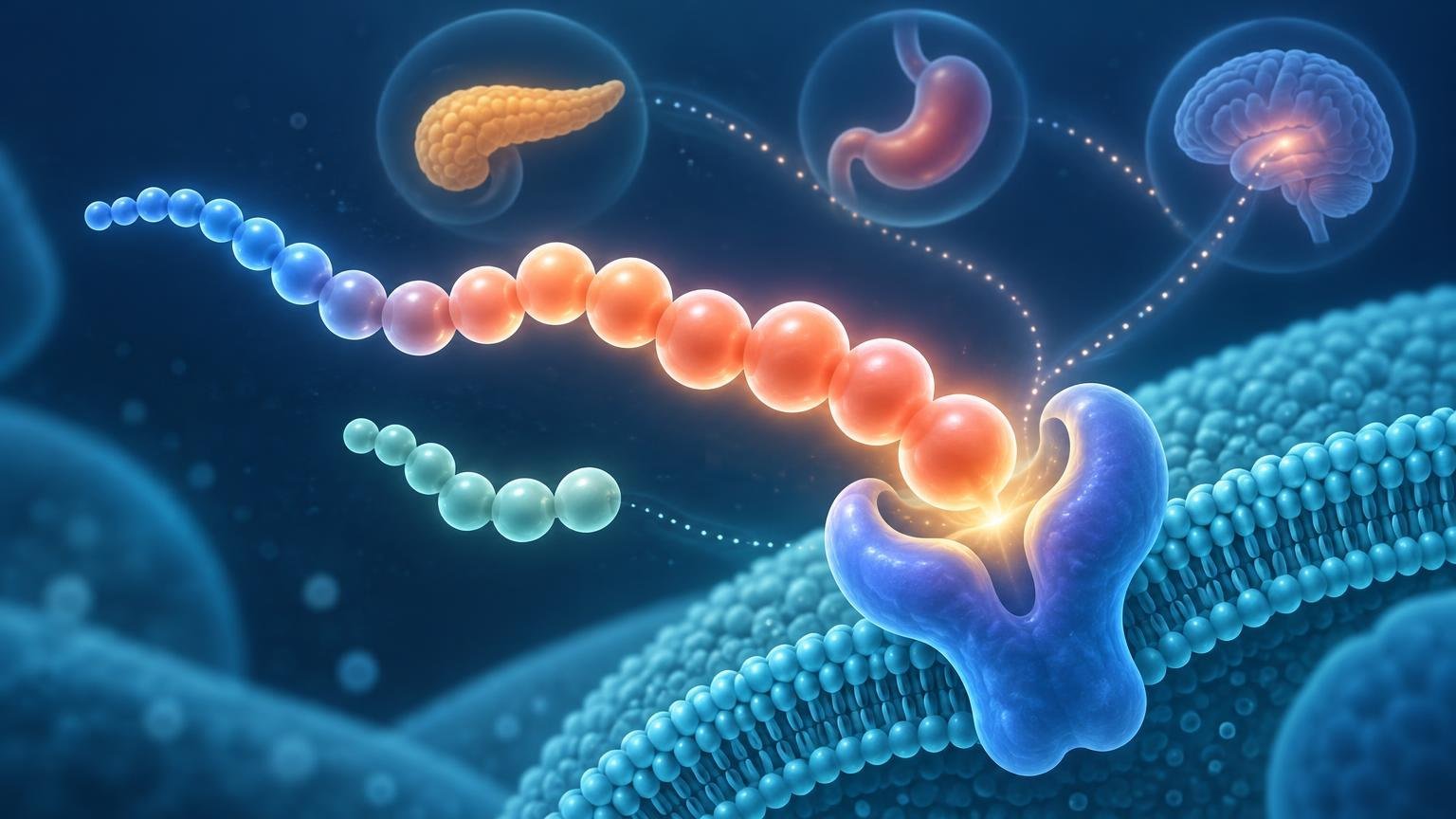
Its structure is based on GLP-1, an endogenous peptide hormone released from the gut after food intake. Endogenous means the body makes it naturally. Semaglutide, by contrast, is a manufactured GLP-1 analogue: a molecule designed to resemble the hormone closely enough to activate the same receptor while behaving differently in circulation.
The terms are related but not interchangeable:
| Term | What it means | How it applies here |
|---|---|---|
| Peptide | A chain of amino acids | Semaglutide has a peptide backbone. |
| Peptide hormone | A naturally produced peptide that carries a biological signal | GLP-1 is an endogenous peptide hormone. |
| GLP-1 analogue | A modified molecule modeled on human GLP-1 | Semaglutide is a GLP-1 analogue. |
| GLP-1 receptor agonist | A substance that activates the GLP-1 receptor | Semaglutide activates this receptor. |
| Protein | A generally larger, folded amino acid structure | Semaglutide is ordinarily classified as a peptide drug, not a conventional protein medicine. |
This distinction prevents a common misunderstanding. “GLP-1” may refer to the natural hormone, the receptor pathway, or—loosely—to an entire drug class. Semaglutide is not literally the same molecule as native GLP-1. For a wider explanation of the difference among hormones, receptors, and drug names, see what GLP-1 terminology actually means.
How semaglutide differs from natural GLP-1
Native GLP-1 is useful as a short-lived meal signal. Once released, it is rapidly broken down, including by an enzyme called dipeptidyl peptidase-4, usually shortened to DPP-4. That brief lifespan is appropriate for moment-to-moment physiology, but inconvenient for a medicine intended to provide sustained receptor activation.
Semaglutide contains structural changes that reduce its susceptibility to DPP-4 degradation. It is also modified to bind strongly to albumin, an abundant protein circulating in blood. Albumin binding effectively provides a traveling reservoir and slows the drug’s clearance. Together, these features help account for semaglutide’s prolonged action and the once-weekly schedule used by injectable formulations.
The underlying molecular development is described in the original semaglutide discovery paper. These modifications do not make semaglutide “more natural.” They make it a longer-acting pharmacological analogue of a natural signal.
What the GLP-1 pathway does in metabolism
Calling semaglutide a peptide identifies its molecular family. Calling it a GLP-1 receptor agonist tells us more about its metabolic activity. When semaglutide activates GLP-1 receptors, several connected processes can change.
Insulin and glucagon responses
Semaglutide increases insulin secretion and reduces glucagon secretion in a glucose-dependent manner. Insulin helps move glucose out of the bloodstream and regulates how nutrients are stored and used. Glucagon generally supports glucose release, particularly when the body needs to defend blood glucose availability. “Glucose-dependent” means the drug’s effect on these secretions varies with glucose conditions rather than operating as a completely fixed signal.
This does not mean semaglutide is insulin. Insulin is a separate peptide hormone with its own receptor and direct metabolic functions. Semaglutide acts primarily through the GLP-1 receptor and influences insulin and glucagon downstream.
Appetite and calorie intake
The prescribing information states that semaglutide reduces calorie intake and affects appetite. GLP-1 signaling participates in communication among the gut, brain, pancreas, and other tissues involved in meal-related physiology. Appetite is not controlled by one hormone, however. Hunger, fullness, food reward, learned behavior, sleep, stress, food availability, and other hormonal signals all contribute.
This is why “it suppresses hunger” is an incomplete metabolic explanation. Semaglutide changes one influential signaling pathway within a larger appetite-regulation system. The relationship between GLP-1 and other signals is explored further in this comparison of ghrelin and GLP-1.
Gastric emptying
Semaglutide can delay gastric emptying, meaning food may move from the stomach into the small intestine more slowly. That can affect post-meal physiology and may matter for symptoms, oral medication absorption, and medical procedures. It is only one part of semaglutide’s action and should not be treated as the sole explanation for appetite or weight changes.
Does semaglutide speed up metabolism?
Not in the simple sense implied by claims that it directly makes the body “burn faster.” The clearest established effects include altered appetite and calorie intake, glucose-dependent pancreatic signaling, and delayed gastric emptying. Those processes can change energy balance, blood glucose, and body weight without requiring a large direct increase in resting energy expenditure.
Energy balance describes the relationship between energy consumed and energy expended over time. A change in appetite can shift that balance, but the body may also adapt during weight loss. Energy expenditure can decline as body mass decreases, while hunger and other compensatory signals can change. Scale weight may also reflect fat mass, lean tissue, glycogen, water, and digestive contents—not fat alone. See how energy intake, expenditure, and adaptation interact for the broader framework.
What human trials establish—and what they do not
Molecular classification should be separated from clinical evidence. Semaglutide is a peptide because of its structure, not because a trial produced a particular outcome. Trials are needed to determine what that molecule does in defined populations under defined conditions.
In STEP 1, researchers randomized adults with overweight or obesity who did not have diabetes to once-weekly semaglutide 2.4 mg or placebo, with lifestyle intervention included in both groups. Over the studied period, the semaglutide group experienced greater average weight loss. The result applies to the trial’s population, regimen, comparator, and follow-up conditions; it does not predict any one person’s response.
SELECT studied semaglutide 2.4 mg weekly in adults with established cardiovascular disease and overweight or obesity but without diabetes. The trial found a reduction in major cardiovascular events relative to placebo in that specific high-risk population, and the FDA announced a corresponding cardiovascular-risk-reduction indication for a specified adult population in March 2024. The precise biological contributions to that outcome are not fully established, so it should not be attributed to appetite change, weight loss, glucose effects, or any single mechanism alone.
These studies answer clinical questions. They do not change the basic classification of semaglutide, and they should not be generalized across different populations or products without considering the actual evidence.
Does being a peptide mean semaglutide must be injected?
No. Peptide medicines are often injected because digestive enzymes can break their amino acid chains apart and because large, water-soluble molecules generally cross the intestinal lining poorly. But “difficult to deliver orally” is not the same as “impossible to formulate orally.” Semaglutide has been developed in both injectable and oral prescription formulations, with different absorption and administration constraints.
Formulation matters because swallowing a peptide does not normally produce the same exposure as injecting it. An oral formulation must address degradation and poor absorption. Readers should therefore not assume that two products containing the same named active molecule are interchangeable in route, exposure, indication, or instructions.
Peptide classification does not guarantee product equivalence
The word “peptide” describes molecular structure; it is not a quality certificate. It does not show that a product contains the correct ingredient, has an approved formulation, was manufactured to the required standard, or has been evaluated for a particular use.
The FDA specifically distinguishes the semaglutide base used in FDA-approved medicines from semaglutide sodium and semaglutide acetate salt forms. The agency also notes that compounded drugs do not undergo FDA premarket review for safety, effectiveness, and quality. An approved prescription medicine, a compounded preparation, and a research-use product should therefore not be treated as interchangeable merely because all are marketed with similar terminology.
Important safety context
Semaglutide is a prescription medicine with contraindications, warnings, adverse effects, and potential interaction considerations. Its peptide origin does not make it automatically mild or safe.
The prescribing information carries a boxed warning concerning thyroid C-cell tumors observed in rodents; whether that finding is relevant to humans is unknown. It lists a personal or family history of medullary thyroid carcinoma and multiple endocrine neoplasia syndrome type 2 as contraindications.
Label-level safety concerns also include pancreatitis, gallbladder disease, kidney injury associated with dehydration, severe gastrointestinal reactions, diabetic-retinopathy considerations, and increased hypoglycemia risk when semaglutide is combined with insulin or medicines that stimulate insulin secretion. Delayed gastric emptying may also matter when other oral medicines are taken or when sedation, anesthesia, or procedures are planned.
Those issues require individualized clinical review. A prescriber can assess the exact product, indication, medical history, concurrent medicines, and relevant procedure planning. This article explains classification and physiology; it does not determine whether semaglutide is appropriate for a particular person.
Frequently asked questions
Is semaglutide a peptide or a protein?
Semaglutide is ordinarily classified as a peptide medicine. Peptides and proteins are both made from amino acids, and the boundary is not perfectly universal, but semaglutide’s structure and pharmacological category fit the peptide designation.
Is semaglutide the same as GLP-1?
No. GLP-1 is a naturally occurring peptide hormone. Semaglutide is a modified GLP-1 analogue that activates the GLP-1 receptor and has 94% sequence homology with human GLP-1. Its modifications help it remain active much longer.
Is semaglutide naturally occurring?
Not as the marketed drug molecule. It is modeled on a naturally occurring hormone but manufactured with deliberate structural modifications. It is better described as an engineered analogue than as natural GLP-1.
Is semaglutide insulin or a steroid?
Neither. Semaglutide is a peptide GLP-1 receptor agonist. Insulin is a different peptide hormone acting through the insulin receptor, while steroids have a fundamentally different chemical structure.
Does peptide status make all semaglutide products equivalent?
No. Molecular naming does not establish formulation, purity, manufacturing quality, regulatory review, route of administration, or approved use. The FDA warns specifically against conflating approved semaglutide base products with semaglutide salt forms and other unapproved GLP-1 products.
The bottom line
Semaglutide is a peptide—specifically, a modified GLP-1 analogue that activates the GLP-1 receptor. Its engineered structure helps protect it from rapid enzymatic breakdown and supports prolonged exposure through albumin binding. Through GLP-1 receptor signaling, it affects appetite and calorie intake, insulin and glucagon secretion, gastric emptying, and blood-glucose regulation.
The most important qualification is that classification is only the starting point. It explains what kind of molecule semaglutide is, but clinical trials establish outcomes, prescribing information defines approved uses and key risks, and the exact formulation determines how a product is administered and regulated. Questions about suitability, interactions, formulation, or procedure planning belong with a qualified prescribing clinician using the latest product information.
References
- Label
- Discovery of the Once-Weekly Glucagon-Like Peptide-1 (GLP-1) Analogue Semaglutide – PubMed
- Once-Weekly Semaglutide in Adults with Overweight or Obesity | New England Journal of Medicine
- Semaglutide and Cardiovascular Outcomes in Obesity without Diabetes | New England Journal of Medicine
- FDA Approves First Treatment to Reduce Risk of Serious Heart Problems Specifically in Adults with Obesity or Overweight | FDA
- www.accessdata.fda.gov
- FDA’s Concerns with Unapproved GLP-1 Drugs Used for Weight Loss | FDA