
TLDR: If you are asking “what is reta peptide,” the term usually means retatrutide, also known by the development code LY3437943. It is an investigational peptide medicine designed to activate three signaling systems: GIP, GLP-1, and glucagon receptors. Human trials have reported substantial effects on body weight and metabolic measures, but retatrutide is not currently an FDA-approved drug, and important questions about long-term safety and outcomes remain.
The important distinction is that retatrutide is not simply “another GLP-1.” Its three-receptor design may affect appetite, food intake, glucose regulation, and energy use through overlapping pathways. That makes the biology interesting, but it does not mean every clinical effect can be assigned neatly to one receptor—or that a plausible mechanism proves a long-term health benefit.
What “reta peptide” actually means
“Reta” is informal shorthand, not a separate medical name. In most online discussions, reta peptide refers to retatrutide, a peptide drug candidate also called LY3437943 during development. A peptide is a chain of amino acids that can carry biological signals. Retatrutide is engineered to interact with specific hormone receptors rather than acting as a general metabolism booster.
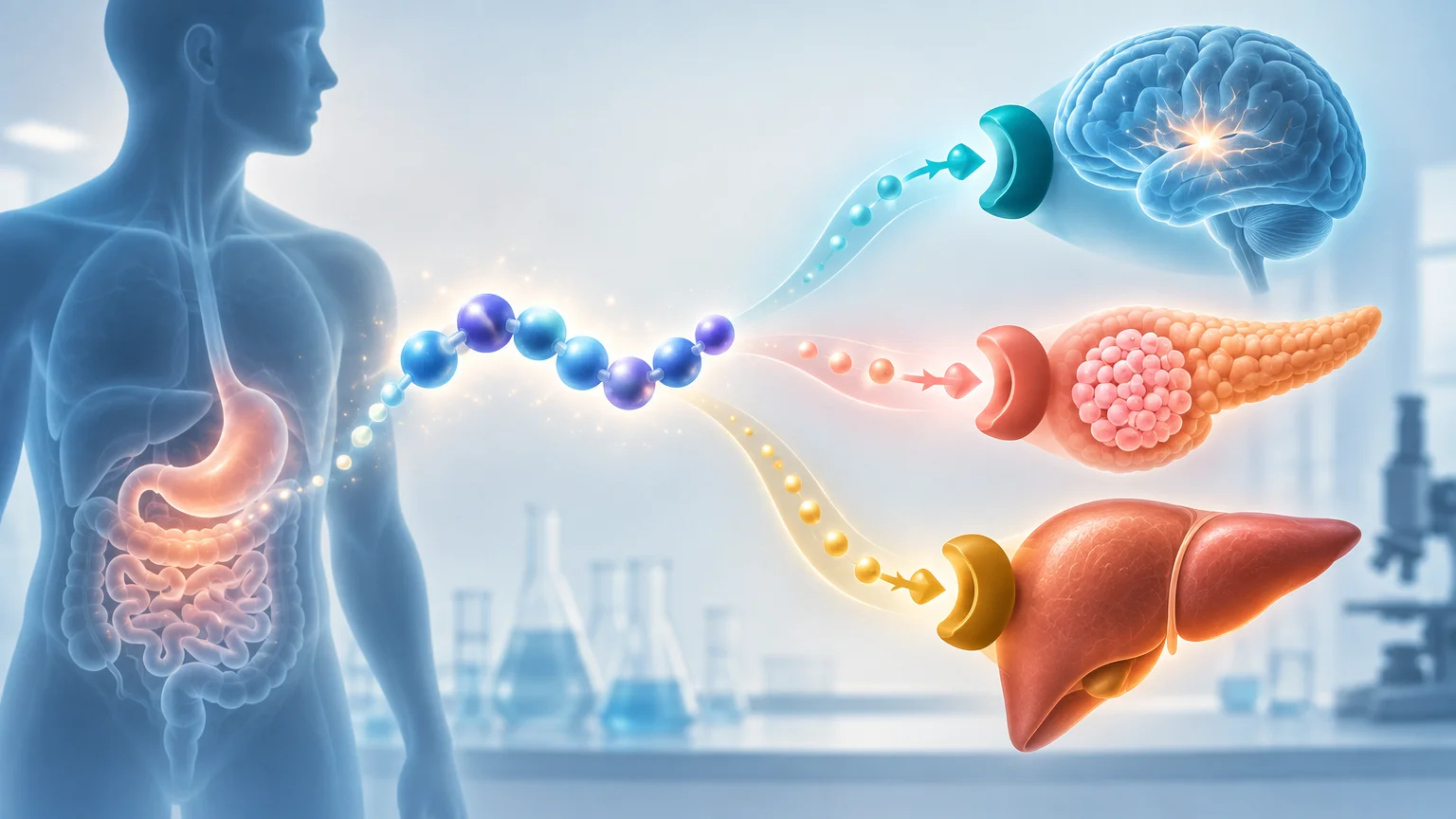
Retatrutide is described as a triple agonist or tri-agonist. An agonist is a molecule that activates a receptor. In this case, one molecule activates receptors for glucose-dependent insulinotropic polypeptide, or GIP; glucagon-like peptide-1, or GLP-1; and glucagon.
Those names describe receptor targets, not three ingredients mixed together. Retatrutide is one investigational molecule with activity at all three receptors. This also explains why labels such as “GLP-3” are misleading: there is no established GLP-3 receptor involved. Readers comparing the terminology can see our explanation of Ozempic, retatrutide, and the confusing “GLP-3” label.
What does a triple agonist do?
The three receptors belong to interconnected systems involved in nutrient handling and energy balance. They do not function as three independent switches. Their effects depend on the tissue, nutritional state, receptor activity, and downstream signals generated elsewhere in the body.
| Target | Normal physiological role in simplified terms | Why it matters to retatrutide research |
|---|---|---|
| GLP-1 receptor | Supports glucose-dependent insulin release, slows aspects of digestive processing, and contributes to fullness and appetite signaling | Offers a well-established route for reducing food intake and improving glucose regulation |
| GIP receptor | Participates in the insulin response to nutrients and also signals in tissues involved in energy storage and regulation | May complement GLP-1 activity, although its contribution cannot be inferred from mechanism alone |
| Glucagon receptor | Helps regulate fuel availability, including signaling that can increase liver glucose output | May influence energy expenditure and fuel use, but it also creates a physiological balancing problem that the combined molecule is designed to address |
GLP-1 and appetite signaling
GLP-1 is released in response to food and helps coordinate the fed state. Activating its receptor can enhance insulin secretion when glucose is elevated and influence brain and gastrointestinal signals involved in satiation—the process that helps end a meal. Reduced energy intake can then lead to weight loss over time.
That sequence matters because weight loss should not automatically be described as proof that a drug “sped up metabolism.” A change in body weight can reflect reduced food intake, altered energy expenditure, shifts in water and glycogen, and changes in fat and lean tissue. Clinical scales capture the total change but do not, by themselves, identify its full cause.
GIP is not just a second version of GLP-1
GIP is another incretin hormone, meaning it is released after nutrients enter the digestive system and helps connect eating to insulin secretion. Its broader role in adipose tissue, appetite, and energy regulation is complex. Retatrutide’s GIP activity may work with GLP-1 signaling, but human trial outcomes do not reveal exactly how much of the effect came from each receptor.
Why activate the glucagon receptor?
Glucagon is often introduced as insulin’s counter-hormone because it can signal the liver to make stored fuel available and raise blood glucose. That can make glucagon-receptor activation sound counterproductive in a drug being studied for obesity and type 2 diabetes.
The proposed rationale is broader: glucagon signaling may affect energy expenditure and fuel metabolism, while the molecule’s GLP-1 and GIP activity supports appetite and glucose control. Early discovery and proof-of-concept research supports this multi-receptor rationale, but the precise contribution of glucagon-receptor activity to weight and metabolic outcomes in people remains unresolved. The published discovery and clinical proof-of-concept paper describes the pharmacological basis for the design.
This is a useful example of why mechanism and outcome must be separated. Retatrutide activates all three receptors, which is an established pharmacological feature. Whether a particular amount of weight change resulted from greater fullness, lower food intake, higher energy expenditure, or interactions among these effects is a more difficult question.
What human research has found so far
The evidence has progressed beyond laboratory and animal experiments. Retatrutide has been studied in randomized human trials, including a peer-reviewed Phase 2 obesity trial, while Phase 3 programs have evaluated it in obesity and type 2 diabetes. Evidence level still matters: a Phase 2 result helps estimate efficacy and identify common safety signals, whereas Phase 3 studies usually test a larger population and provide evidence intended to support regulatory evaluation.
Peer-reviewed Phase 2 obesity evidence
A randomized Phase 2 trial enrolled adults with obesity, or overweight plus at least one weight-related condition, and compared retatrutide with placebo over 48 weeks. Participants assigned to retatrutide had greater average reductions in body weight than the placebo group. The trial therefore provides human evidence of a clinical effect, not merely a theoretical prediction from receptor biology. The peer-reviewed Phase 2 trial report provides the study design, endpoints, results, and adverse-event data.
The result should still be read in context. It came from a controlled trial with defined eligibility criteria, scheduled follow-up, and a limited duration. An average does not show how every participant responded, and a 48-week study cannot settle safety or effectiveness over many years. It also does not establish that products sold online under the same molecule name have the identity, purity, formulation, or oversight of the material used in the trial.
Phase 3 research
TRANSCEND-T2D-1 is a registered randomized, double-blind Phase 3 study comparing retatrutide with placebo in adults with type 2 diabetes whose glucose control was inadequate with diet and exercise alone. Its existence shows that the research program has advanced, but registration of a trial is not the same as regulatory approval. ClinicalTrials.gov lists the TRANSCEND-T2D-1 study details.
Eli Lilly has also announced topline findings from Phase 3 obesity studies. These reports can establish what the sponsor says its trials found, but company announcements are not interchangeable with complete peer-reviewed publications. Detailed papers are needed to evaluate participant characteristics, statistical methods, missing data, subgroup findings, adverse events, and the precise endpoint definitions.
The responsible summary is therefore neither “only an animal experiment” nor “a proven approved treatment.” Retatrutide has meaningful randomized human evidence and an advanced clinical-development program, while its overall benefit-risk profile and regulatory status remain under evaluation.
Safety signals and unanswered questions
In the Phase 2 obesity trial, gastrointestinal adverse events were common. This category includes symptoms affecting the digestive system and is familiar from research on incretin-based medicines, but similarity to another drug class should not be used to assume identical tolerability. The trial also observed dose-related increases in heart rate.
Those findings need proportionate interpretation. A signal observed in a trial is not automatically proof of serious long-term harm, but it should not be dismissed simply because average weight loss was large. Longer and larger trials are better positioned to assess persistence, uncommon adverse events, discontinuation, and whether changes in measures such as heart rate translate into clinically important outcomes.
Other open questions include how weight loss is divided among fat mass and lean mass, how outcomes differ among populations, what happens after prolonged use or discontinuation, and whether retatrutide improves cardiovascular or kidney outcomes. Weight reduction and improved glucose markers can be clinically meaningful, but they do not by themselves prove fewer heart attacks, less kidney failure, or lower mortality.
- Established so far: retatrutide is a single molecule with GIP, GLP-1, and glucagon receptor activity.
- Supported by human trials: it can produce greater average weight reduction than placebo in the studied Phase 2 population.
- Observed safety findings: gastrointestinal adverse events and dose-related increases in heart rate were reported in Phase 2.
- Not yet settled: multi-year safety, uncommon adverse events, long-term body-composition effects, and cardiovascular or kidney outcome benefits.
- Mechanistically unresolved: the share of the clinical effect attributable to each receptor pathway.
Is retatrutide FDA-approved?
No. The FDA states that retatrutide is not a component of an FDA-approved drug and has not been found safe and effective for any condition. The agency also identifies retatrutide among unapproved GLP-1-related substances that cannot be used in compounding under federal law. The FDA’s notice on unapproved GLP-1-related drugs explains the agency’s current position.
This distinction is especially important when the phrase “reta peptide” appears on a commercial website or social-media account. A shared chemical name does not establish that an online product is equivalent to the investigational medicine used in a regulated trial. It does not confirm manufacturing quality, sterility, purity, dose accuracy, formulation, or suitability for human use.
Likewise, labels such as “research use only” do not turn a substance into an approved treatment. Clinical-trial participation operates through formal protocols, eligibility criteria, informed consent, controlled supply, and safety monitoring. It is fundamentally different from obtaining an unapproved product outside a trial.
Frequently asked questions
Is reta peptide the same as retatrutide?
Usually, yes. “Reta peptide” is informal shorthand commonly used for retatrutide, or LY3437943. Because informal product labels can be ambiguous, the name alone does not establish a product’s contents or regulatory status.
Is retatrutide a GLP-1 drug?
It has GLP-1 receptor activity, but calling it only a GLP-1 drug leaves out two parts of its design. Retatrutide also activates GIP and glucagon receptors, which is why researchers call it a triple agonist.
Is retatrutide the same as semaglutide or tirzepatide?
No. These are distinct molecules with different receptor profiles. Semaglutide targets the GLP-1 receptor, while tirzepatide targets GIP and GLP-1 receptors. Retatrutide adds glucagon-receptor activity. Outcomes from separate trials should not be treated as a head-to-head ranking because trial populations, durations, comparators, and analysis methods may differ.
Has retatrutide been proven safe?
Clinical trials provide safety data, but “proven safe” is too absolute. Phase 2 research identified common gastrointestinal events and increases in heart rate, while larger and longer studies are needed to characterize less common and long-term risks. The FDA has not approved retatrutide as safe and effective for any condition.
Do the trial results prove retatrutide increases metabolism?
Not in the simple sense often implied online. The triple-receptor design may affect food intake, glucose regulation, energy expenditure, and fuel use, but a reduction in scale weight does not isolate the contribution of each process. Controlled metabolic and body-composition measurements are needed to separate them more clearly.
The bottom line
Reta peptide usually means retatrutide: an investigational, single-molecule agonist of GIP, GLP-1, and glucagon receptors. Its mechanism is broader than GLP-1 signaling alone, and randomized human research supports meaningful effects on weight and metabolic measures in the populations studied.
The strongest limitation is equally clear. Retatrutide is not currently FDA-approved, sponsor-reported topline findings are not a substitute for complete peer-reviewed Phase 3 reports, and long-term benefits and risks remain under study. The useful next step is to judge new claims by their evidence level: receptor theory for mechanism, peer-reviewed trials for clinical effects, trial registries for study status, and FDA sources for approval and regulatory questions.
References
- LY3437943, a novel triple glucagon, GIP, and GLP-1 receptor agonist for glycemic control and weight loss: From discovery to clinical proof of concept – ScienceDirect
- Triple–Hormone-Receptor Agonist Retatrutide for Obesity — A Phase 2 Trial | New England Journal of Medicine
- FDA’s Concerns with Unapproved GLP-1 Drugs Used for Weight Loss | FDA
- Study Details | NCT06354660 | Effect of Retatrutide Compared With Placebo in Adult Participants With Type 2 Diabetes and Inadequate Glycemic Control With Diet and Exercise Alone (TRANSCEND-T2D-1) | ClinicalTrials.gov
- Efficacy and safety of retatrutide, a GIP, GLP-1, and glucagon receptor agonist, in people with type 2 diabetes and inadequate glycaemic control with diet and exercise (TRANSCEND-T2D-1): a double-blind, randomised, phase 3 trial – PubMed
- Lilly's triple agonist, retatrutide, delivered powerful weight loss in pivotal Phase 3 obesity trial | Eli Lilly and Company
- Lilly's triple agonist, retatrutide, successful in two additional Phase 3 obesity trials, delivering significant improvements in weight and A1C | Eli Lilly and Company