
TLDR
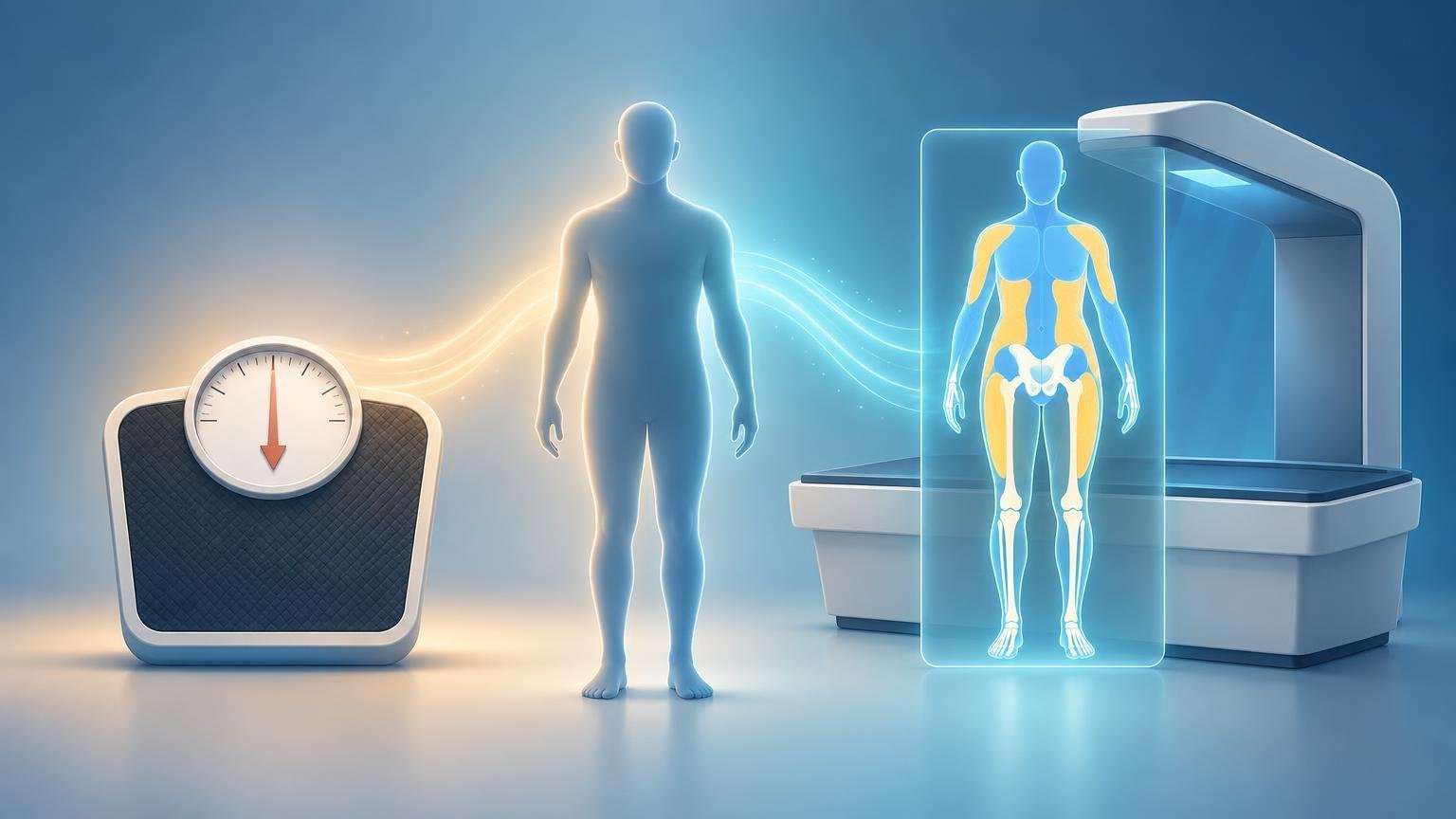
In a DXA vs body weight clinical trial comparison, the scale answers how much total body mass changed. Dual-energy X-ray absorptiometry, usually abbreviated DXA or DEXA, estimates how that mass is distributed among fat, lean soft tissue, and bone mineral. That extra detail can show whether weight reduction came predominantly from fat, but a decline in DXA lean mass must not automatically be described as an equal loss of skeletal muscle. DXA does not directly measure muscle tissue quality, strength, or physical function.
This distinction matters when interpreting obesity and incretin-drug trials. A large reduction in scale weight can occur alongside reductions in both fat mass and DXA-estimated lean mass. Those findings are not contradictory: total weight is the sum of multiple changing compartments. The scientifically useful question is not simply whether lean mass declined, but what was measured, how it was measured, and whether the trial also assessed strength or function.
DXA vs body weight clinical trial outcomes at a glance
| Measure | What it tells researchers | What it cannot establish alone |
|---|---|---|
| Scale weight | Total body mass and its change in kilograms, pounds, or percentage terms | How much of the change was fat, lean tissue, water, or another component |
| DXA fat mass | An estimate of total and sometimes regional fat mass | Why fat changed or whether every metabolic benefit resulted from fat loss |
| DXA lean mass | An estimate of non-fat, non-bone soft tissue | Direct skeletal-muscle mass, muscle quality, strength, or physical function |
| DXA bone mineral content | An estimate of the mineral component detected by the scan | A complete assessment of bone strength or fracture risk |
| Strength or function testing | Performance on a specified task, such as a strength or mobility assessment | Body composition unless a separate measurement is performed |
What scale weight establishes
Body weight is a direct, accessible outcome: it records the combined mass of fat, lean tissue, bone, body water, and other contents at the time of measurement. Trials commonly express change in kilograms and as a percentage of baseline weight. Percentage change helps put the result in context because the same kilogram loss represents a different proportion of the starting weight for different participants.
A scale cannot identify which compartments changed. It also cannot tell researchers whether an early change reflects mostly tissue loss or shorter-term shifts in body water and other contents. That does not make scale weight a weak endpoint. It makes it an endpoint for a different question: how much did total mass change?
The larger trial still matters more than a small imaging subgroup for estimating the treatment’s average body-weight effect in the randomized population. Readers can use a broader framework for interpreting weight-loss trial results to check the comparator, analysis population, missing data, and treatment discontinuation alongside the headline percentage.
What DXA adds to a weight-loss trial
DXA sends two low-dose X-ray beams through the body and uses their differing attenuation to estimate body compartments. In body-composition research, the resulting outputs commonly include fat mass, lean soft tissue, and bone mineral content. Some protocols also provide regional estimates, including measurements intended to characterize abdominal or visceral adiposity. Standardized acquisition, positioning, analysis, and repeatability procedures matter when comparing scans over time.
This lets investigators ask a question the scale cannot answer: how was the observed weight change partitioned? If body weight falls while fat mass falls by a larger percentage than lean mass, the scan provides evidence that the reduction was predominantly adipose tissue. It does not mean lean tissue was perfectly preserved, nor does it show that every kilogram assigned to the lean compartment was skeletal muscle.
DXA may be performed in a substudy rather than in every participant because imaging adds equipment, trained personnel, scheduling, quality-control, and site-standardization requirements. A substudy can therefore add biological context without replacing the parent trial’s body-weight endpoint. Its narrower sample also creates an interpretive limitation: researchers must ask whether scanned participants adequately represent the full randomized population.
Why DXA lean mass does not equal skeletal muscle
The term “lean mass” sounds more anatomically specific than it is. DXA lean soft tissue includes non-fat, non-bone material across the body. Skeletal muscle contributes substantially, but the compartment also contains water and non-muscle tissues. A review of GLP-1 receptor agonist-based therapies therefore describes DXA-derived fat-free mass as a crude surrogate for skeletal muscle rather than a direct muscle measurement.
This creates an important language rule: a trial reporting a 10% decline in DXA lean mass has not necessarily demonstrated a 10% decline in skeletal muscle. Changes in hydration and other components included in the lean estimate can affect the result. Scanner procedures, positioning, analysis choices, and repeatability also influence how confidently a change can be interpreted.
Nor does a body-composition scan establish functional consequences. Muscle amount, tissue quality, strength, and physical performance are related but distinct concepts. A favorable fat-to-lean loss proportion cannot prove that strength was preserved. Conversely, a measured decline in lean mass does not by itself prove weakness, disability, or sarcopenia. Those questions require suitable functional and clinical outcomes in addition to imaging.
How semaglutide and tirzepatide substudies illustrate the distinction
The STEP 1 exploratory DXA analysis
STEP 1 was a randomized trial of semaglutide in adults with overweight or obesity, with body-weight change evaluated in the parent trial. A subsequent publication reported an exploratory DXA analysis intended to place that weight change in body-composition context. It examined changes in measures including total fat mass, visceral fat, and lean body mass in the participants included in the imaging analysis.
“Exploratory” is important. The analysis can help explain how weight change was distributed, but it should not be treated as if DXA outcomes were measured with equal completeness across the entire parent-trial population. It also does not transform a lean-mass estimate into a direct measurement of muscle tissue or function.
The SURMOUNT-1 DXA substudy
SURMOUNT-1 evaluated tirzepatide for weight reduction in adults with obesity or overweight. Its DXA substudy reported 72-week results for 160 participants who had both baseline and end-of-study scans. In pooled tirzepatide recipients, mean changes were −21.3% in body weight, −33.9% in fat mass, and −10.9% in lean mass. The authors characterized approximately 75% of the lost weight as fat mass and approximately 25% as lean mass.
Those figures demonstrate why a single percentage can be misleading. Fat and lean mass both declined, but fat mass fell much more in proportional terms. The reported 75-to-25 partition describes the average composition of weight lost in that particular substudy and analysis. It does not mean each participant had that ratio, and it does not show that the lean component consisted entirely of skeletal muscle.
Why these are not head-to-head results
The STEP 1 and SURMOUNT-1 imaging analyses should not be used to declare one medicine superior at preserving lean tissue. They came from different trials, with different populations, durations, substudy samples, analytical decisions, and potentially different scanning conditions. Only a suitably designed randomized head-to-head study using consistent measurement procedures could support a direct comparative conclusion.
Even then, the interpretation would depend on what “preservation” means. A smaller percentage reduction in DXA lean mass is a body-composition finding. Preserved muscle strength, mobility, or physical function would require corresponding performance outcomes.
The FDA context: useful guidance, not universal monitoring
The FDA’s draft guidance on developing drugs and biological products for weight reduction recommends baseline and follow-up body-composition assessment by DXA or a suitable alternative in a representative sample. The purpose is to help show whether weight reduction is primarily attributable to fat rather than lean mass. Read the FDA’s draft weight-reduction drug guidance.
The status and scope of that document matter. It is draft, nonbinding guidance for drug development. It does not establish that every participant in every obesity trial must receive DXA, and it is not a recommendation that every person losing weight needs routine scanning. Clinical development evidence and individual medical assessment are separate contexts.
A practical checklist for reading DXA results
Before accepting a statement such as “the treatment caused muscle loss” or “the treatment preserved muscle,” check whether the underlying paper answers these questions:
- Population: Who entered the trial, and did eligibility depend on age, health conditions, or baseline body size?
- Sample: How many randomized participants had usable scans at both baseline and follow-up?
- Representativeness: Did the DXA subgroup resemble the full trial population?
- Comparator: Was the change compared with placebo, another intervention, or baseline alone?
- Duration: Was the scan taken during active weight reduction, after a plateau, or during maintenance?
- Terminology: Does the paper report lean mass, lean soft tissue, fat-free mass, appendicular lean mass, or an actual muscle-imaging measure?
- Measurement quality: Were scanner platforms, calibration, positioning, acquisition, and analysis procedures standardized?
- Missing data: Were only participants with complete scans analyzed, and could dropout have biased the result?
- Units: Are results absolute amounts, percentages of baseline, or proportions of total weight lost?
- Function: Were strength, mobility, exercise capacity, or other objective functional outcomes measured?
Absolute and percentage changes answer different questions. Someone starting with more fat mass may lose a large absolute amount while showing a percentage similar to another participant. The proportion of lost weight assigned to fat or lean mass is different again: it divides compartment change by total weight change. These figures should not be interchanged.
Energy balance also helps explain why multiple compartments can fall together. During sustained negative energy balance, the body draws on stored energy while adapting to lower intake and changing body size. Fat is the main intended source of substantial weight reduction, but body composition is not static. For background on the system connecting intake and expenditure, see this explanation of energy balance in weight regulation.
Frequently asked questions
Does lower DXA lean mass prove muscle loss?
No. It supports a decline in the scan’s estimated lean compartment. Skeletal muscle may account for some of that change, but DXA does not isolate muscle from all other lean soft tissue. More specific imaging and functional tests are needed to characterize muscle quantity, quality, strength, and performance.
Can fat mass and lean mass both fall during successful weight reduction?
Yes. Total body weight combines multiple compartments, so both can decline while fat accounts for most of the overall loss. The scientifically relevant details are the magnitude of each change, the methods used, and whether functional outcomes changed.
Is DXA more important than scale weight?
Neither measure universally outranks the other. Scale weight directly answers how much total mass changed and can be collected throughout a large trial. DXA adds information about estimated composition, often in a smaller subgroup. Together they answer more than either measure alone.
Does a favorable fat-to-lean loss ratio prove muscle was preserved?
No. It indicates that a larger share of the measured weight reduction came from fat than from the DXA lean compartment. Muscle preservation is a stronger claim that should be supported by muscle-specific and functional evidence.
Why not scan every participant?
DXA requires suitable equipment, trained staff, standardized procedures, and quality control across trial sites. Researchers may use a representative substudy to obtain body-composition context while keeping the main trial feasible. The tradeoff is a smaller sample and greater concern about representativeness and missing scans.
Bottom line
Body weight and DXA are complementary, not competing, outcomes. The scale measures total mass change; DXA estimates how that mass is partitioned. In weight-reduction trials, DXA can show that fat accounts for most of the average loss while also detecting a decline in the estimated lean compartment.
The responsible interpretation stops short of equating that lean-mass decline with direct skeletal-muscle loss or functional impairment. When reading a trial, identify the scanned population, comparator, duration, measurement methods, missing-data approach, and any strength or performance outcomes. That turns a dramatic “muscle loss” headline back into the narrower—and more useful—measurement the study actually reported.
References
- The Official Positions of the International Society for Clinical Densitometry: acquisition of dual-energy X-ray absorptiometry body composition and considerations regarding analysis and repeatability of measures.
- Glucagon-like peptide-1 receptor agonist-based agents and weight loss composition: Filling the gaps – PubMed
- Once-Weekly Semaglutide in Adults with Overweight or Obesity – PubMed
- Impact of Semaglutide on Body Composition in Adults With Overweight or Obesity: Exploratory Analysis of the STEP 1 Study – PMC
- Tirzepatide Once Weekly for the Treatment of Obesity – PubMed
- Body composition changes during weight reduction with tirzepatide in the SURMOUNT‐1 study of adults with obesity or overweight – Look – 2025 – Diabetes, Obesity and Metabolism – Wiley Online Library
- Obesity and Overweight: Developing Drugs and Biological Products for Weight Reduction