
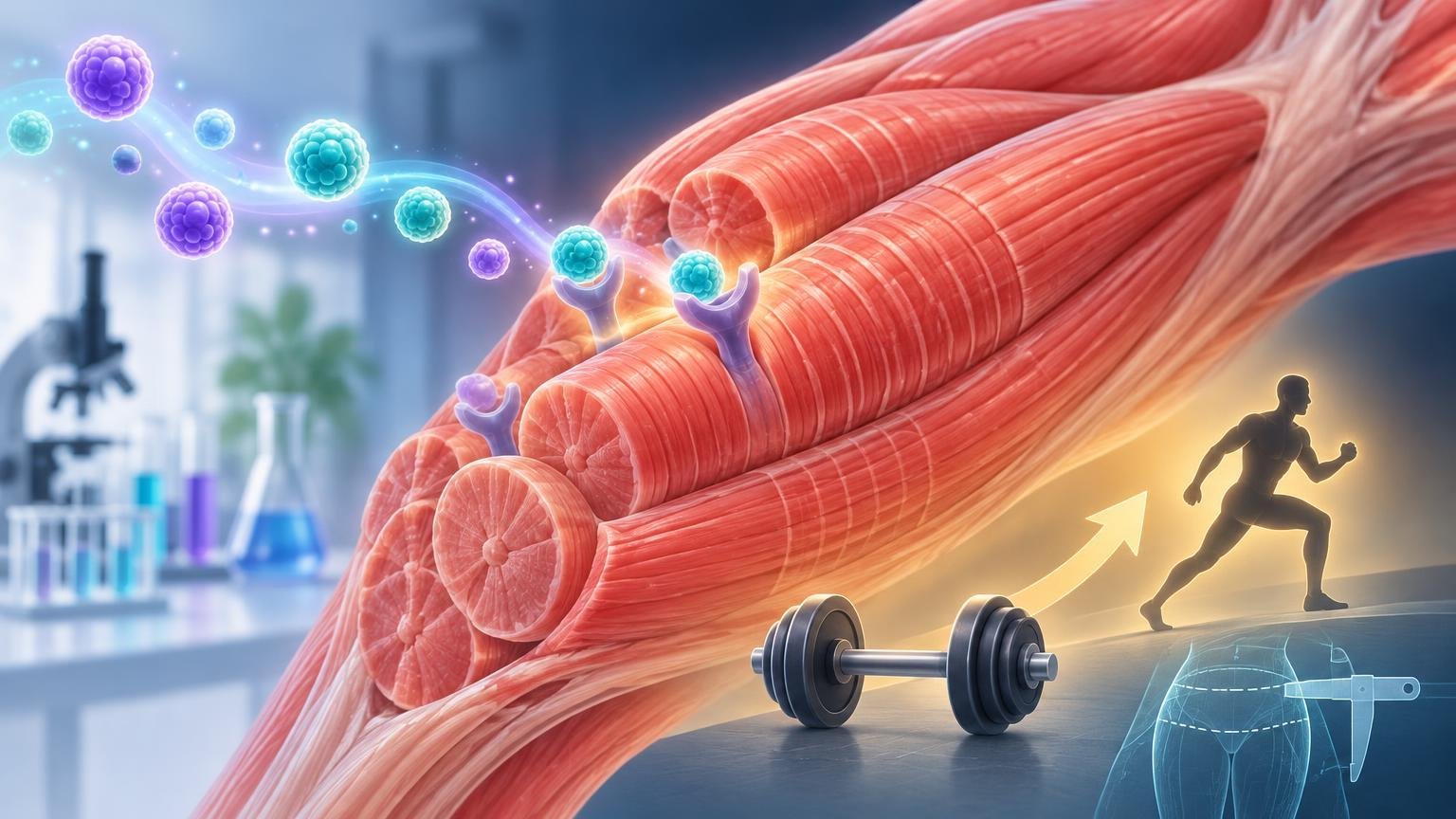
If you are asking what peptides help with muscle growth, the evidence-based answer is less exciting than the marketing: no commonly promoted peptide can currently be recommended as a safe, proven way to build useful muscle in healthy adults. Some compounds raise growth hormone or IGF-1, and some experimental medicines increase measured lean mass in specific patient populations. Those findings do not automatically mean greater contractile muscle, strength, athletic performance, or long-term health.
The crucial question is not simply what peptides help with muscle growth, but what researchers actually measured. A change in a hormone concentration or body-composition scan is several steps removed from demonstrating durable hypertrophy. The most informative evidence would show that a compound adds muscle tissue, improves strength or physical function, and has an acceptable safety profile in the relevant population. Most marketed peptides do not meet that standard.
What counts as meaningful muscle growth?
Muscle hypertrophy means enlargement of muscle fibers, usually in response to repeated mechanical tension and sufficient recovery. Trials rarely measure every part of that process directly. Instead, they may report growth hormone levels, IGF-1 concentrations, body weight, fat-free mass, lean body mass, muscle imaging, strength, or performance. These outcomes are related, but they are not interchangeable.
| Outcome | What it can show | What it cannot prove by itself |
|---|---|---|
| Higher GH or IGF-1 | A biological pathway was stimulated | That muscle fibers grew or strength improved |
| Higher body weight | Total mass increased | Whether the gain was muscle, fat, water, or another tissue |
| Higher lean or fat-free mass | Non-fat mass increased on the measurement used | That all of the increase was contractile skeletal muscle |
| Larger muscle on imaging | A specific muscle or muscle group increased in size | That strength, mobility, or athletic performance improved |
| Greater strength | Performance improved on a defined test | How much of the change came from hypertrophy rather than technique or neural adaptation |
| Better physical function | A practical task improved | That the result applies to healthy, resistance-trained adults |
Lean mass includes more than contractile muscle. Depending on the method, it can reflect water, organs, connective tissue, glycogen-associated water, and other non-fat components. This is why a body-composition result should be interpreted alongside strength and function. Our explanation of DXA versus scale weight in clinical trials explores this measurement problem in more detail.
Growth hormone signaling is not the same as hypertrophy
Growth hormone, or GH, is released by the pituitary gland and influences metabolism directly and through insulin-like growth factor 1, commonly called IGF-1. The pathway affects tissue growth, protein turnover, fat metabolism, fluid balance, and glucose regulation. It is biologically plausible that altering this pathway could change body composition, but plausibility is not proof of useful muscle growth.
A systematic review and meta-analysis of placebo-controlled GH trials in healthy young adults found changes in body composition without a significant improvement in muscle strength or aerobic capacity. The review is available through PubMed’s record of the GH performance meta-analysis. This is an important reality check: even direct pharmacological manipulation of the GH axis did not establish the performance benefit that a muscle-building claim would imply.
Prescription growth hormone also has legitimate medical uses. FDA-approved therapy includes treatment of adults with diagnosed growth hormone deficiency, which is different from using GH or GH-stimulating compounds for elective bodybuilding. Evidence and risk-benefit decisions for a hormone-deficient patient cannot be transferred automatically to a healthy person seeking more muscle.
Are CJC-1295 and ipamorelin proven muscle builders?
CJC-1295 is an analog of growth hormone-releasing hormone. It is intended to stimulate the body's GH axis rather than supply GH directly. In a randomized study of healthy adults, CJC-1295 produced prolonged increases in GH and IGF-1 secretion. However, this was a pharmacology study of hormone responses—not a trial demonstrating hypertrophy, greater strength, or improved athletic performance.
That distinction is easy to lose in marketing. Showing that a compound reaches its biological target answers “Does it alter this pathway?” It does not answer “Does it build useful muscle?” A convincing answer to the second question would require appropriate training controls, reliable muscle measurements, functional outcomes, sufficient follow-up, and systematic safety monitoring.
Ipamorelin is another GH secretagogue commonly discussed alongside CJC-1295. The supplied evidence does not establish that it produces meaningful muscle or strength gains in healthy adults. FDA has separately identified safety concerns or limited safety information for CJC-1295 and ipamorelin in its evaluation of substances used in compounding. Combining two substances that influence the same endocrine axis does not fill the evidence gap, and it may make effects and harms harder to predict.
MK-677 can increase fat-free mass, but it is not a peptide
Ibutamoren, also known as MK-677, is frequently grouped with “peptides,” but it is an orally active ghrelin mimetic rather than a peptide. It stimulates the ghrelin receptor and can increase GH secretion. Ghrelin biology also intersects with appetite and glucose metabolism, so the potential consequences extend beyond muscle.
In a randomized trial involving healthy older adults, ibutamoren increased fat-free mass but did not improve strength or physical function. The study also identified worsened fasting glucose and insulin sensitivity as metabolic concerns. The population matters: older adults experiencing age-related changes are not equivalent to healthy young lifters. Even within that older population, an increase in fat-free mass did not translate into better function.
IGF-1 and MGF claims go beyond the clinical evidence
IGF-1 participates in growth signaling and muscle protein regulation, making it an attractive basis for muscle-building claims. But systemic manipulation of this pathway is not a muscle-specific switch. IGF-1 signaling occurs across multiple tissues and interacts with glucose regulation, cell growth, and the wider GH axis.
Mecasermin is a recombinant human IGF-1 medicine with narrow medical uses related to severe primary IGF-1 deficiency and certain cases involving growth hormone gene deletion with neutralizing antibodies. That regulatory context does not support its use for hypertrophy in healthy adults. A medicine can be appropriate for a rare deficiency while having an unfavorable or unknown risk-benefit balance for elective physique enhancement.
Mechano growth factor, often shortened to MGF, refers to an IGF-1-related splice variant discussed in muscle biology. Products marketed as PEG-MGF are sometimes presented as if the pathway itself proves a clinical effect. It does not. FDA includes PEG-MGF among substances for which it has identified significant safety concerns or insufficient safety information in the compounding context. Biological relevance is not evidence that a marketed preparation safely causes hypertrophy in people.
Myostatin inhibition shows why lean mass and function can diverge
Myostatin is part of a signaling system that restrains skeletal-muscle growth. Blocking myostatin or related activin pathways is a legitimate area of drug development, particularly for diseases involving muscle weakness or wasting. It is also a useful test of a common assumption: if muscle-related tissue increases, function must improve proportionally.
In a randomized trial of bimagrumab in older adults with sarcopenia, the investigational treatment increased lean body mass but did not improve physical function more than placebo when both groups received nutrition and exercise support. This does not mean lean mass is unimportant. It means a scan-based change alone is an incomplete clinical result.
Disease-focused studies also cannot be converted into bodybuilding recommendations. A treatment developed for sarcopenia or a neuromuscular disorder is evaluated in a population with different baseline biology, goals, vulnerabilities, and acceptable risks. Results from such trials do not establish effectiveness or safety for muscle gain in healthy adults.
BPC-157 and TB-500 are not established hypertrophy treatments
BPC-157 and TB-500-related products are usually promoted around injury recovery, tissue repair, or reduced downtime rather than direct hypertrophy. Even if faster recovery could theoretically support more consistent training, that indirect argument would still require evidence. It cannot substitute for controlled human trials showing greater muscle growth, strength, or return to function.
FDA has identified safety concerns or limited safety information for BPC-157 and a TB-500-related thymosin beta-4 fragment in the compounding context. These substances therefore are not evidence-based answers to a muscle-growth question. Claims drawn from biochemical or animal findings should not be presented as established human outcomes.
The metabolic tradeoffs matter
The GH and IGF-1 axis affects more than skeletal muscle. Manipulating it may change fluid balance, glucose handling, insulin sensitivity, appetite-related signaling, and the distribution of fat and lean tissue. A higher lean-mass value can therefore coexist with an undesirable metabolic change, as illustrated by the ibutamoren trial's glucose findings.
Long-term uncertainty is especially important for compounds that lack robust clinical development for the proposed use. Short pharmacology studies can identify hormone changes and common immediate adverse effects, but they are poorly suited to establish uncommon harms or years-long cardiometabolic, reproductive, immune, or cell-growth risks. Unknown safety is not the same as demonstrated safety.
Product quality creates another layer of uncertainty. A compounded or research-use-only product is not interchangeable with an FDA-approved medicine used for an established indication. Identity, purity, sterility, dose consistency, clinical evidence, and regulatory review are separate questions. An analytical label or online claim cannot establish that a product is appropriate for human use.
Tested athletes have an additional compliance problem
Athletes subject to anti-doping rules should not assume that an unapproved or casually marketed substance is permitted. The relevant list changes over time and may address GH-releasing factors, secretagogues, IGF-related agents, and myostatin or activin-pathway modifiers. Athletes need to check the applicable year's World Anti-Doping Agency Prohibited List and the rules governing their specific competition rather than relying on a seller's description.
What actually supports muscle gain?
For healthy adults, the evidence-based foundation remains progressive resistance training, enough dietary energy to support the goal, adequate protein, and sufficient recovery and sleep. These factors are less novel than a peptide stack, but they directly address the repeated mechanical stimulus and raw materials required for adaptation.
Progress should also be judged with more than one metric. Scale weight can provide context, while repeated strength tests, training performance, circumference measurements, and body-composition methods each answer different questions. Short-term weight or lean-mass changes may partly reflect glycogen and water, so trends over time are more informative than a single reading.
Unexplained loss of muscle, strength, physical function, or body weight is a different situation from elective enhancement. It can occur with inadequate nutrition, endocrine disorders, gastrointestinal disease, chronic inflammation, medication effects, neurological conditions, cancer, or other illnesses. Clinical assessment is more appropriate than attempting to self-correct a suspected hormone problem with an unapproved peptide.
The bottom line
No commonly marketed peptide has convincing evidence of safely producing meaningful, durable muscle and strength gains in healthy adults. CJC-1295 demonstrates GH-axis stimulation, not proven hypertrophy. Ipamorelin lacks adequate outcome evidence for this use. MK-677 is not a peptide and increased fat-free mass without improving strength or function in an older-adult trial. IGF-1 medicines have narrow medical indications, while myostatin-pathway research shows that increased lean mass can occur without a matching functional benefit.
The most useful filter is to ask what changed: a hormone, total weight, lean mass, a directly measured muscle, strength, or real-world function. The farther the reported outcome is from strength and function—and the less closely the study population resembles healthy adults seeking hypertrophy—the weaker the muscle-building conclusion becomes.
Frequently Asked Questions
Do any commonly marketed peptides reliably build useful muscle in healthy adults?
No commonly marketed peptide has convincing evidence that it safely produces durable muscle, strength, and functional gains in healthy adults.
Why does increased lean mass not necessarily prove muscle growth?
Lean mass can include water, organs, connective tissue, glycogen-associated water, and other non-fat components. It should be interpreted alongside direct muscle measurements, strength, and physical function.
Are CJC-1295 and ipamorelin proven muscle builders?
No. CJC-1295 increased GH and IGF-1 in a healthy-adult pharmacology study, but the study did not demonstrate hypertrophy, strength, or performance benefits. Adequate outcome evidence for ipamorelin is also lacking. FDA has identified safety concerns or limited safety information for both substances in the compounding context.
Is MK-677 a peptide, and does it improve strength?
MK-677, or ibutamoren, is an oral ghrelin mimetic rather than a peptide. In a trial of healthy older adults, it increased fat-free mass without improving strength or physical function; worsened fasting glucose and insulin sensitivity were also concerns.
Does raising GH or IGF-1 prove meaningful muscle growth?
No. Higher hormone levels show that a biological pathway was stimulated, not that contractile muscle, strength, or function improved. A meta-analysis of GH trials in healthy young adults found body-composition changes without significant gains in strength or aerobic capacity.
Is mecasermin appropriate for healthy adults seeking hypertrophy?
Its recognized medical uses concern severe primary IGF-1 deficiency and certain cases involving growth hormone gene deletion with neutralizing antibodies, not elective muscle gain in healthy adults.
Do myostatin inhibitors improve lean mass and physical function equally?
Not necessarily. In older adults with sarcopenia, bimagrumab increased lean body mass but did not improve physical function more than placebo when both groups received nutrition and exercise support.
Why are BPC-157 and TB-500 not evidence-based muscle-growth treatments?
Controlled human evidence has not established that they increase hypertrophy, strength, or function. FDA has also identified safety concerns or limited safety information for BPC-157 and a TB-500-related fragment in the compounding context.
What should tested athletes consider before using these compounds?
They should check the applicable year’s World Anti-Doping Agency Prohibited List and their competition rules rather than relying on a seller’s description. The list may address GH-releasing factors, secretagogues, IGF-related agents, and myostatin or activin-pathway modifiers.
References
- Prolonged stimulation of growth hormone (GH) and insulin-like growth factor I secretion by CJC-1295, a long-acting analog of GH-releasing hormone, in healthy adults – PubMed
- Effects of an oral ghrelin mimetic on body composition and clinical outcomes in healthy older adults: a randomized trial – PubMed
- Impact of GH administration on athletic performance in healthy young adults: A systematic review and meta-analysis of placebo-controlled trials – PubMed
- FDA approves weekly therapy for adult growth hormone deficiency | FDA
- Certain Bulk Drug Substances for Use in Compounding that May Present Significant Safety Risks | FDA
- Search Orphan Drug Designations and Approvals
- Bimagrumab vs Optimized Standard of Care for Treatment of Sarcopenia in Community-Dwelling Older Adults: A Randomized Clinical Trial – PubMed
- WORLD ANTI-DOPING CODE