
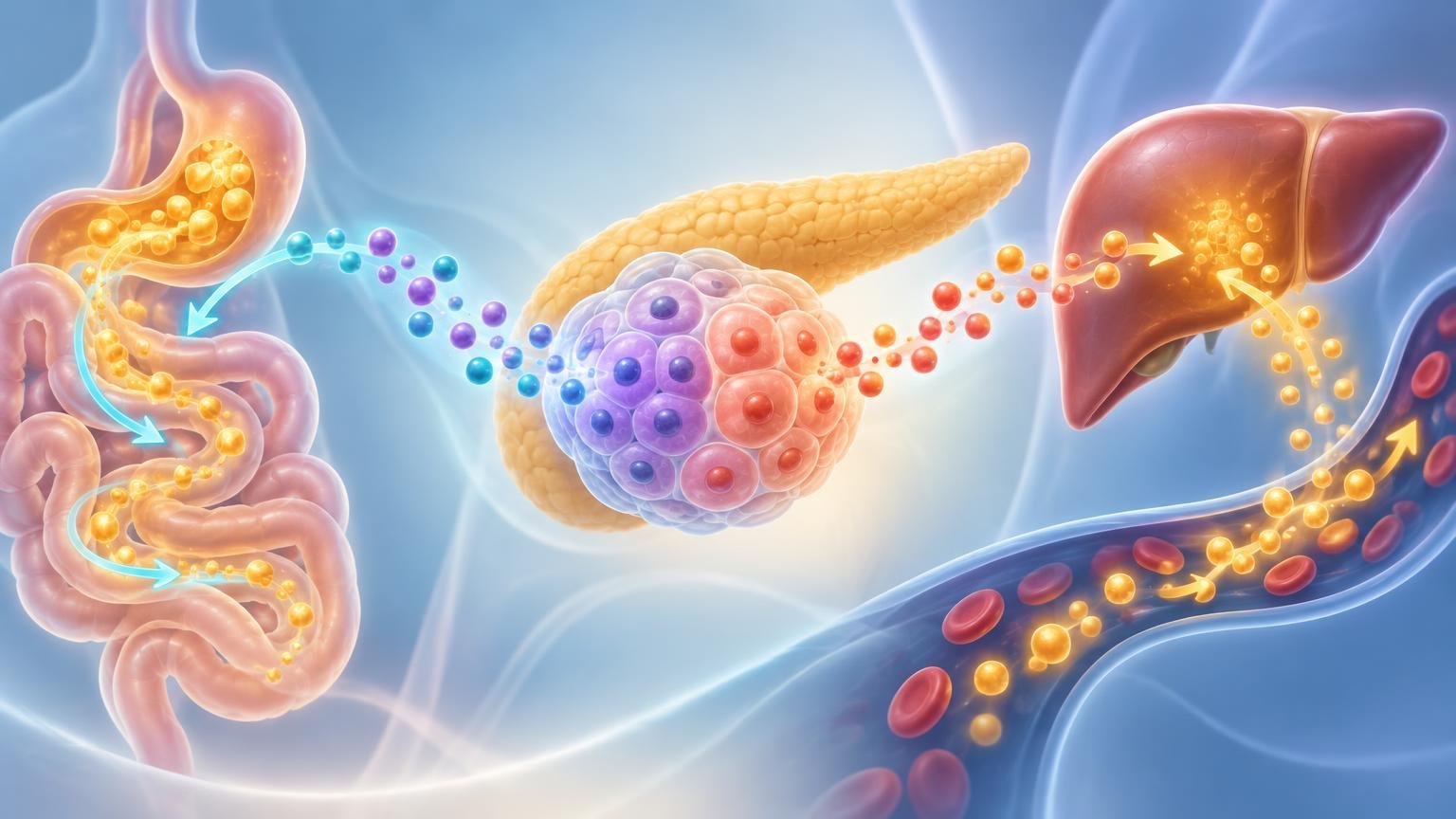
Amylin and glucagon are both pancreatic peptide hormones, but they are not metabolic opposites in any simple sense. Amylin is released alongside insulin from beta cells, especially after eating. It helps coordinate the handling of incoming nutrients by slowing gastric emptying, supporting satiety and restraining the meal-related rise in glucagon. Glucagon, released primarily from alpha cells, becomes especially important when the body needs to defend circulating glucose by mobilizing fuel from the liver.
The shortest useful comparison is this: amylin helps control how quickly a meal enters the metabolic system, while glucagon helps keep fuel available when food-derived energy is limited. Their actions overlap in glucose regulation, but their secretion patterns, receptors and broader physiological roles are substantially different.
Where amylin and glucagon come from
Amylin, also called islet amyloid polypeptide or IAPP, is a 37-amino-acid peptide. Pancreatic beta cells co-secrete it with insulin in response to nutrient intake. That pairing makes physiological sense: insulin helps tissues store and use nutrients, while amylin influences how quickly those nutrients arrive and how much food is consumed during the meal.
Glucagon is a 29-amino-acid peptide released mainly by pancreatic alpha cells. Its best-established role is maintaining blood glucose during fasting and responding to falling glucose. The liver is its principal metabolic target. The NCBI overview of glucagon physiology describes glucagon as a central regulator of hepatic glucose output during fasting and hypoglycemia.
| Feature | Amylin | Glucagon |
|---|---|---|
| Primary pancreatic source | Beta cells | Alpha cells |
| Typical physiological context | Released with insulin after nutrient intake | Important during fasting and falling glucose |
| Major immediate effects | Slower gastric emptying, greater satiety and reduced post-meal glucagon secretion | Increased hepatic glucose output |
| Receptor system | Calcitonin receptor combined with a RAMP protein | Glucagon receptor |
| Main metabolic theme | Coordinates nutrient arrival and meal size | Mobilizes stored fuel |
Amylin regulates the pace of a meal
Amylin affects metabolism partly by controlling nutrient delivery rather than simply changing glucose use inside a cell. Slower gastric emptying means carbohydrates and other nutrients move from the stomach into the small intestine more gradually. That can reduce the speed at which meal-derived glucose appears in circulation. Amylin-related signaling also promotes satiety and is associated with smaller meals.
Its receptor biology is more complicated than the phrase “amylin receptor” suggests. Amylin acts through complexes formed from a calcitonin receptor and one of several receptor activity-modifying proteins: RAMP1, RAMP2 or RAMP3. These different complexes contribute to the pharmacology of amylin-family signaling. The IUPHAR review of calcitonin-family peptide pharmacology provides a detailed account of this receptor system.
These actions distinguish amylin from insulin. Insulin directly supports glucose uptake and storage in responsive tissues and restrains hepatic glucose production. Amylin complements that response by changing gastric emptying, appetite signaling and post-meal glucagon secretion. It is part of a coordinated response to eating, not a substitute for insulin.
Glucagon protects access to stored fuel
Glucagon addresses a different metabolic problem: keeping usable fuel available between meals, during fasting or when glucose falls. It binds to the glucagon receptor, a G-protein-coupled receptor expressed prominently in the liver. Signaling through pathways that include cyclic AMP and protein kinase A tells the liver to increase fuel output.
In the shorter term, glucagon promotes glycogenolysis—the release of glucose from glycogen stored in the liver. As fasting continues and liver glycogen declines, gluconeogenesis becomes more important. Gluconeogenesis is the production of glucose from substrates such as lactate, glycerol and certain amino acids. Glucagon also supports hepatic fatty-acid oxidation and ketone production in low-energy states.
That counterregulatory function matters because insulin is not the only hormone controlling blood glucose. When glucose falls, the body reduces insulin secretion and recruits responses that restore fuel availability. Glucagon is one of the most important rapid signals telling the liver to release glucose.
Does amylin turn glucagon off?
No. Amylin is better described as suppressing nutrient-stimulated or postprandial glucagon secretion. That qualification matters because glucagon remains necessary during fasting and hypoglycemia. A hormone that moderates an inappropriate meal-related signal does not necessarily eliminate the liver’s ability to respond when glucose availability is threatened.
Research involving pramlintide, an amylin analog, illustrates the distinction. In people with type 1 diabetes, pramlintide added to insulin reduced post-meal glucagon and glucose excursions and slowed the appearance of meal-derived glucose. Other clinical work found that the liver retained responsiveness during an induced glucagon challenge.
These are pharmacological findings, not proof that endogenous amylin always produces effects of the same size or timing. They also should not be transferred automatically to every investigational medicine that targets an amylin-related pathway.
Why the distinction matters in diabetes
Type 1 diabetes involves loss of pancreatic beta-cell function, so the deficit extends beyond insulin to other beta-cell products, including amylin. At the same time, glucagon regulation can become abnormal. Excess glucagon activity in an insulin-deficient state can worsen hyperglycemia and support excessive ketone production.
Pramlintide provides a clinical example of targeting the amylin pathway, but it remains distinct from endogenous amylin. FDA prescribing information describes Symlin, or pramlintide acetate, as an adjunct to mealtime insulin for certain adults with type 1 or type 2 diabetes who use mealtime insulin. It is not a replacement for insulin. The label also carries a boxed warning about severe hypoglycemia when pramlintide is used with insulin, particularly in type 1 diabetes. The FDA prescribing information for Symlin contains the complete approved-use and safety details.
Amylin, glucagon and incretin drugs are separate systems
Amylin should not be folded into the GLP-1 category simply because both pathways can affect appetite, gastric emptying or post-meal glucose. GLP-1, GIP, glucagon and amylin have different secretion sites, receptor systems and physiological roles. Readers can review the related incretin pathway in our explanation of what glucagon-like peptide-1 is and how it differs from glucagon.
The same distinction applies to drug development. A medicine combining GLP-1 and glucagon-receptor activity is pharmacologically different from an amylin-pathway agent, even if both are being studied for weight or metabolic outcomes. Similar headline goals do not make the underlying biology interchangeable.
The metabolic takeaway
Amylin and glucagon are best understood as coordinators for different nutritional states. After a meal, amylin helps regulate nutrient arrival, satiety and the glucagon response. During fasting or falling glucose, glucagon tells the liver to make stored and newly produced fuel available.
Calling one hormone “good” and the other “bad” misses the physiology. Healthy metabolism depends on timing, context and coordination. Amylin helps prevent incoming nutrients from overwhelming the system too quickly; glucagon helps prevent the system from running short of accessible fuel. Their interaction matters, but their jobs are fundamentally different.
References
- Amylin Revisited: A 5-Year Perspective on Its Emerging Role in the Treatment of Diabesity
- Glucagon Physiology
- Inverse relation between amylin and glucagon secretion in healthy and diabetic human subjects.
- Pramlintide, an amylin analog, selectively delays gastric emptying: potential role of vagal inhibition
- Update on the pharmacology of calcitonin/CGRP family of peptides: IUPHAR Review 25
- Chapter 1. Hypoglycemia Physiology and Diverse Consequences
- Inhibition of glucagon secretion.
- Effect of Pramlintide on Postprandial Glucose Fluxes in Type 1 Diabetes
- Amylin regulation of carbohydrate metabolism.
- www.accessdata.fda.gov
- Advances in the clinical measurement of glucagon: from diagnosis to therapy
- Incretins and amylin: neuroendocrine communication between the gut, pancreas, and brain in control of food intake and blood glucose