
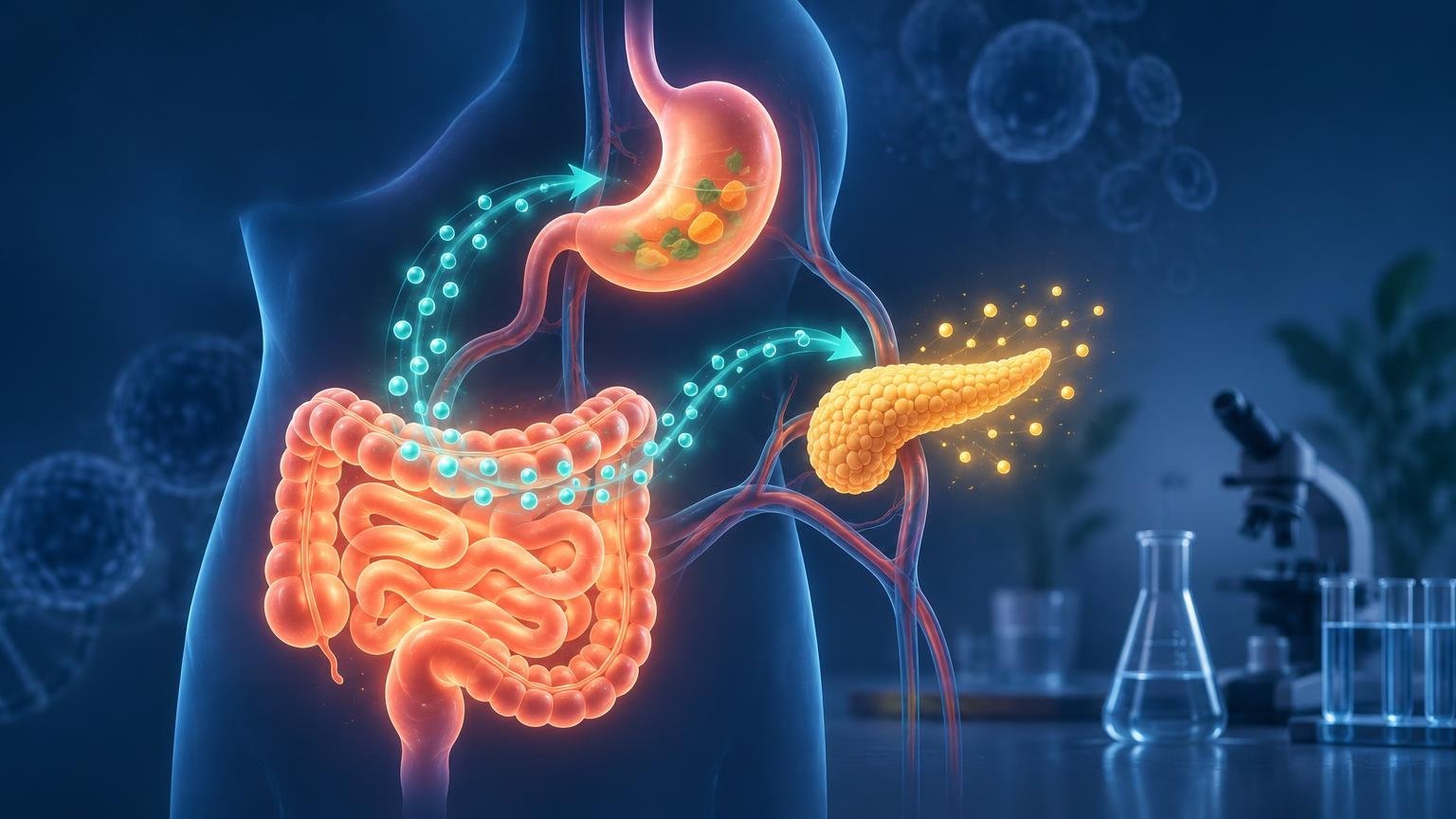
What is glucagon-like peptide-1? Usually shortened to GLP-1, it is a peptide hormone released from the gut in response to nutrients. It helps the body manage an incoming meal by coordinating insulin secretion, glucagon signaling and the rate at which food leaves the stomach. GLP-1 is also an incretin, meaning it is part of the gut-to-pancreas signaling system that supports the insulin response after eating.
Natural GLP-1 is not a weight-loss drug, and it is not the same hormone as glucagon. It is a short-lived biological signal made by the body. Prescription medicines called GLP-1 receptor agonists imitate selected parts of that signal but are engineered to act much longer. Understanding the natural hormone first makes it easier to interpret what those medicines do—and what cannot be inferred from GLP-1 physiology alone.
What is glucagon-like peptide-1 in metabolic terms?
GLP-1 is best understood as a meal-coordination signal. When nutrients enter the digestive system, specialized intestinal cells release GLP-1. The hormone then communicates with several tissues, including the pancreas and gastrointestinal tract. Its effects help match the handling of glucose and other nutrients to the rate at which they are arriving.
This is more precise than calling GLP-1 an “insulin booster” or a “fullness hormone.” Insulin secretion is one part of its physiology, but GLP-1 also affects glucagon, gastric emptying and signaling involved in appetite. These processes interact. None operates as a simple on-off switch, and appetite in particular reflects multiple hormonal, neural, sensory and environmental influences. The broader review of GLP-1 physiology describes it as a gut-derived regulator with several connected metabolic actions.
Where GLP-1 comes from
GLP-1 is produced from a larger precursor protein called proglucagon. Glucagon also comes from proglucagon, which explains the “glucagon-like” part of the name. Different tissues process the precursor in different ways, producing hormones with distinct functions. GLP-1 and glucagon are therefore related by origin but are not interchangeable signals.
Two biologically active forms commonly discussed in human physiology are GLP-1(7–36) amide and GLP-1(7–37). A controlled study in healthy participants found that these forms had indistinguishable metabolic effects under the conditions tested. That biochemical detail matters in research, but most readers can treat “active GLP-1” as the relevant category when learning the basic physiology.
What GLP-1 does after a meal
It supports glucose-dependent insulin secretion
When blood glucose is elevated, GLP-1 helps pancreatic beta cells secrete insulin. Insulin then supports glucose uptake and storage while restraining processes that would add more glucose to the circulation. The phrase “glucose-dependent” is important: the strength of this insulin-supporting signal is linked to the glucose environment rather than being completely independent of it.
This does not mean GLP-1 single-handedly controls post-meal glucose. The amount and type of food, the speed of digestion, insulin sensitivity, pancreatic function, physical activity and other hormones all contribute. GLP-1 is one coordinator within that larger system.
It can suppress glucagon after eating
Glucagon is a pancreatic hormone that generally signals the liver to make glucose available, especially when the body needs to defend against low blood sugar or meet energy demands. After a meal, GLP-1 can suppress glucagon secretion as part of the coordinated response to incoming nutrients. Together, increased insulin support and reduced glucagon signaling can limit an excessive rise in post-meal glucose.
That does not make glucagon “bad.” Its glucose-raising role is essential in the appropriate physiological setting. Metabolic regulation depends on timing and context: a signal that is useful during fasting may need to be restrained after carbohydrate-containing food arrives.
It can slow gastric emptying
Gastric emptying is the movement of stomach contents into the small intestine. Slowing this process can reduce the rate at which nutrients, including absorbable carbohydrate, reach the intestine and enter circulation. GLP-1 can therefore influence post-meal glucose partly by changing nutrient delivery, not merely by changing pancreatic hormone secretion.
In a controlled study of healthy humans, infused GLP-1 slowed gastric emptying in a dose-dependent manner. In that specific experimental setting, the effect on gastric emptying outweighed the hormone’s insulin-stimulating effect in determining the glucose response. This is valuable mechanistic evidence, but it should not be generalized into a claim that gastric emptying always dominates in every person or with every GLP-1-based medicine.
It participates in appetite signaling
GLP-1 receptor signaling also contributes to the physiological systems that influence appetite and food intake. However, describing GLP-1 as a single “fullness switch” is misleading. Hunger and satiety emerge from overlapping gut signals, brain circuits, nutrient sensing, learned behavior and the food environment. The comparison of ghrelin and GLP-1 signaling provides a closer look at why neither hormone controls appetite by itself.
Why GLP-1 is more than an insulin signal
A metabolism-first view connects three events: how quickly nutrients arrive, how much insulin the pancreas releases and whether glucagon continues telling the liver to supply glucose. GLP-1 influences all three. Slower gastric emptying changes the timing of nutrient appearance; glucose-dependent insulin secretion helps dispose of incoming glucose; and glucagon suppression can reduce competing glucose output from the liver.
This coordination explains why a change in post-meal glucose cannot automatically be attributed to more insulin. The observed result may reflect altered nutrient delivery, pancreatic signaling or both. It also explains why two interventions that activate the same receptor can produce different overall effects if their duration, receptor activity, exposure pattern or additional pharmacology differs.
Why the body’s own GLP-1 signal is short-lived
Native GLP-1 does not remain active for long. An enzyme called dipeptidyl peptidase-4, usually abbreviated DPP-4, rapidly inactivates much of the active hormone. Other clearance processes also contribute. This rapid turnover makes endogenous GLP-1 well suited to act as a brief signal tied to nutrient intake, but it limits how long an individual release episode can influence metabolism.
The short lifetime of natural GLP-1 is one of the most important differences between physiology and pharmacology. A medicine designed to resist degradation or remain in circulation for an extended period creates a different exposure pattern from the body’s brief post-meal signal. Shared receptor activity does not make the two experiences biologically identical.
Natural GLP-1 versus GLP-1 receptor agonist medicines
| Term | What it describes | Key distinction |
|---|---|---|
| Endogenous GLP-1 | A peptide hormone released by the body in response to nutrients | It is rapidly inactivated and participates in normal meal-related signaling. |
| GLP-1 receptor agonist | A medicine designed to activate the GLP-1 receptor | Its molecular design and duration differ from native GLP-1, and clinical effects depend on the specific product. |
| Dual GIP/GLP-1 receptor agonist | A medicine that activates both GIP and GLP-1 receptors | Its effects cannot be attributed to GLP-1 receptor activity alone. |
| Glucagon | A distinct hormone produced from the same proglucagon precursor | It has a different physiological role and generally helps make glucose available when needed. |
Semaglutide is one example of a GLP-1 receptor agonist identified as such in FDA prescribing information. It is a modified peptide medicine rather than a supply of ordinary, short-lived endogenous GLP-1. Readers interested in its molecular classification can see why semaglutide is considered a peptide while still differing substantially from the natural hormone.
Tirzepatide requires another distinction. It activates both GIP and GLP-1 receptors, so describing it as a GLP-1-only medicine leaves out part of its pharmacology. More broadly, casual phrases such as “GLP-1 drug” can group together agents with different structures, receptor profiles and durations.
The same caution applies to investigational multi-receptor compounds. Retatrutide, for example, is being studied as an agonist at GIP, GLP-1 and glucagon receptors. That is a different pharmacological proposition from reproducing natural GLP-1 alone, as the discussion of what retatrutide is explains.
Why drug effects and safety cannot be read directly from hormone physiology
Medication warnings, contraindications, adverse effects and interactions are product-specific. For example, FDA prescribing information for semaglutide identifies it as a GLP-1 receptor agonist while also providing safety information that belongs to that drug product and its approved use—not to ordinary endogenous GLP-1 circulating after a meal.
Gastrointestinal effects also should not be reduced to a single universal explanation. GLP-1-based therapies can affect gastric, intestinal and biliary motility, but the pattern may vary by agent and with treatment duration. Gastric-emptying effects may also change over time. Evidence from an acute infusion of native GLP-1 cannot prove that every longer-acting medicine will produce the same magnitude or duration of effect.
How to interpret GLP-1 claims accurately
When encountering a headline about GLP-1, first identify what the term refers to. Is the claim about the body’s natural hormone, a receptor, an approved single-receptor medicine, a dual agonist or an investigational multi-receptor compound? Those categories are related, but they are not equivalent.
- Check the evidence level: a biochemical experiment, animal study, short human physiology study and Phase 3 clinical trial answer different questions.
- Identify the measured outcome: insulin secretion, gastric emptying, post-meal glucose, appetite rating, food intake, body weight and body composition are separate endpoints.
- Look for the population and duration: an acute study in healthy volunteers cannot establish long-term outcomes in people with diabetes or obesity.
- Separate mechanism from clinical effect: activating a receptor may provide a plausible explanation, but clinical benefits and harms must be measured directly.
- Avoid assuming a class-wide effect: receptor profile, molecular structure, exposure and treatment duration can materially change the result.
The practical definition to remember
Glucagon-like peptide-1 is a short-lived, meal-responsive peptide hormone and incretin. It helps coordinate the movement of nutrients through the stomach with pancreatic insulin and glucagon responses, contributing to post-meal glucose regulation. It also participates in broader appetite signaling, but it is not a stand-alone controller of hunger, body weight or metabolism.
The most useful distinction is between the endogenous hormone and medicines that target its receptor. Natural GLP-1 explains the biological pathway. Drug-specific trials and official prescribing information explain what a particular medicine has been shown to do, for whom it is approved and which safety considerations apply. Keeping those two evidence layers separate prevents a real physiological mechanism from being stretched into claims it does not prove.
Frequently Asked Questions
What is GLP-1 in simple terms?
GLP-1 is a peptide hormone released from the gut after nutrient intake. It helps coordinate digestion, pancreatic hormone signaling and post-meal glucose regulation.
Where is GLP-1 made, and when is it released?
Specialized intestinal cells release GLP-1 in response to nutrients entering the digestive system.
Why is GLP-1 called an incretin?
It is part of the gut-to-pancreas signaling system that supports insulin secretion after eating, particularly when glucose is elevated.
How does GLP-1 affect insulin and glucagon after a meal?
GLP-1 supports glucose-dependent insulin secretion and can suppress glucagon, helping coordinate the body’s response to incoming nutrients.
How does GLP-1 affect gastric emptying?
GLP-1 can slow the movement of stomach contents into the small intestine, changing how quickly nutrients become available. A controlled study demonstrated a dose-dependent effect in healthy participants, but that result should not be generalized to every person or medicine.
Is GLP-1 the same hormone as glucagon?
No. Both originate from the precursor proglucagon, but they are distinct hormones with different physiological roles.
Why does the body’s own GLP-1 signal fade quickly?
Native GLP-1 is rapidly inactivated, largely by the enzyme DPP-4, with other clearance processes also contributing.
Are GLP-1 receptor agonist medicines the same as natural GLP-1?
No. They activate the GLP-1 receptor but differ from the body’s short-lived hormone in molecular design and exposure. Semaglutide is a GLP-1 receptor agonist, while tirzepatide activates both GIP and GLP-1 receptors.
Why can gastrointestinal effects differ among GLP-1-based medicines?
Effects on gastric, intestinal and biliary motility can vary by agent and treatment duration. Evidence from acute native-GLP-1 studies therefore cannot establish the magnitude or duration of effects for every longer-acting medicine.
References
- The physiology of glucagon-like peptide 1 – PubMed
- Biological effects and metabolic rates of glucagonlike peptide-1 7-36 amide and glucagonlike peptide-1 7-37 in healthy subjects are indistinguishable – PubMed
- Glucagon-like peptide 1 inhibition of gastric emptying outweighs its insulinotropic effects in healthy humans – PubMed
- Physiology and Pharmacology of Effects of GLP-1-based Therapies on Gastric, Biliary and Intestinal Motility – PubMed
- label
- Mechanisms of action and therapeutic applications of GLP-1 and dual GIP/GLP-1 receptor agonists – PubMed
- Glucose kinetics: an update and novel insights into its regulation by glucagon and GLP-1 – PubMed