
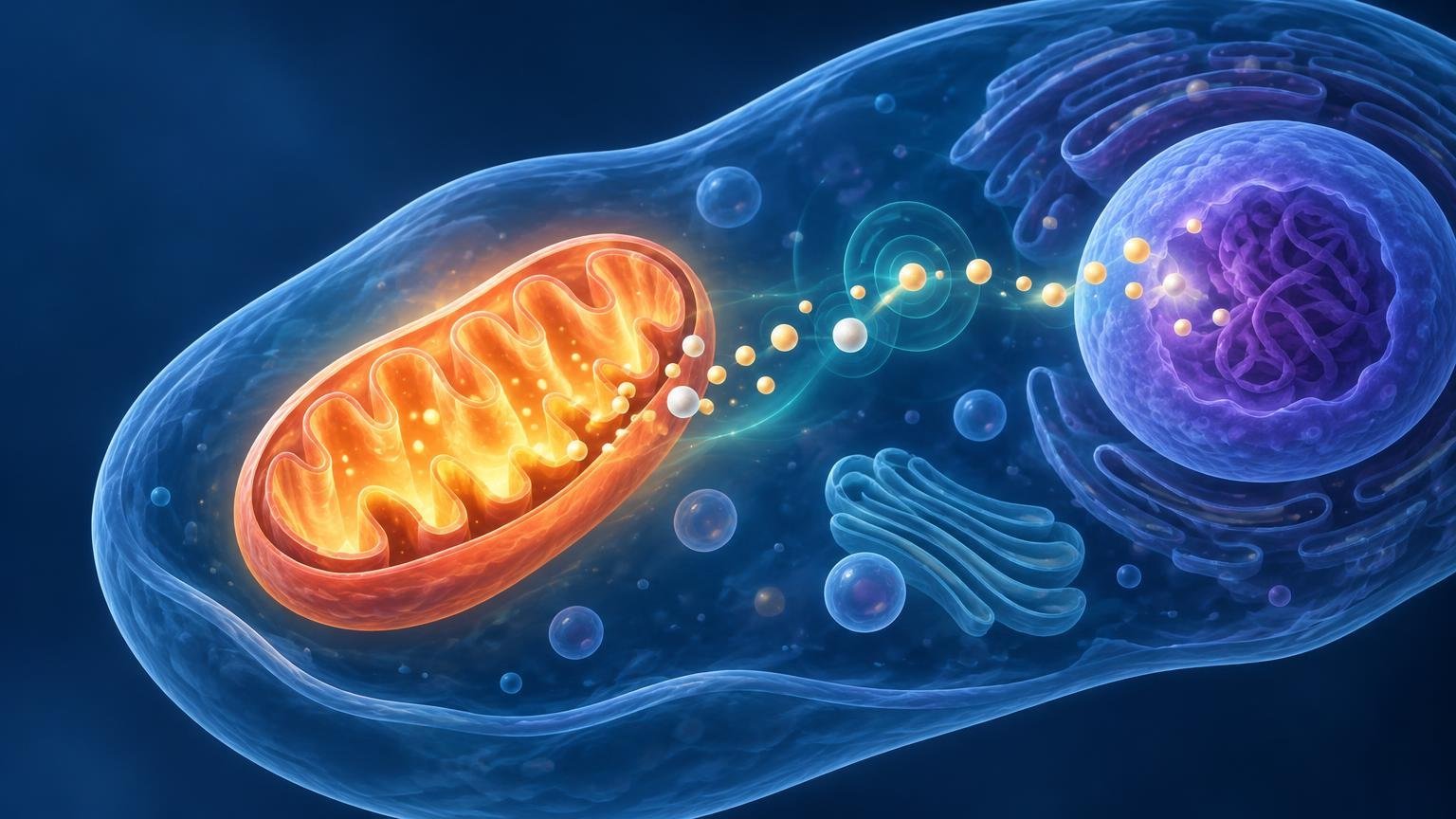
MOTS-c acetate is a salt form of MOTS-c, a 16-amino-acid mitochondrial-derived peptide studied for its possible role in cellular responses to metabolic stress. The acetate label describes how the peptide is presented chemically; it does not identify a different amino-acid sequence or prove that the acetate form has a distinct biological or therapeutic effect.
The evidence is also much earlier than some descriptions imply. Cell and animal experiments provide a rationale involving metabolic-stress signaling, AMPK and communication between mitochondria and the nucleus. Human studies have examined naturally produced, or endogenous, MOTS-c in exercise physiology, but that is not evidence that externally administered MOTS-c acetate treats obesity, diabetes, insulin resistance, aging or impaired athletic performance.
What is MOTS-c acetate?
MOTS-c belongs to a group called mitochondrial-derived peptides: short signaling molecules associated with genetic information in mitochondrial DNA. Mitochondria are best known for helping cells convert nutrients into usable energy, but they also participate in stress sensing and signaling. MOTS-c research asks whether a small peptide connected to mitochondria helps coordinate those wider responses.
A research catalog identifies human MOTS-c acetate as a 16-amino-acid peptide with the sequence MRWQEMGYIFYPRKLR and lists 2,234.64 daltons as the molecular weight of its acetate-form product. That figure is catalog chemistry information for the listed material, not a universal regulatory specification or evidence of clinical-grade quality.
| Reference feature | What it means |
|---|---|
| Peptide length | 16 amino acids |
| Reported human sequence | MRWQEMGYIFYPRKLR |
| Acetate designation | The peptide is supplied as an acetate salt rather than acetate being an amino acid in the sequence |
| Catalog-listed molecular weight | 2,234.64 Da for one supplier’s acetate-form product |
| Evidence category | Primarily biochemical, cell and animal research; human administration evidence has not been established in the supplied record |
MOTS-c acetate versus free-base MOTS-c
Peptides contain chemical groups that can gain or lose protons depending on conditions. During synthesis and purification, oppositely charged ions may remain associated with a charged peptide to produce an electrically neutral salt. In MOTS-c acetate, acetate acts as a counterion. It is not inserted into the chain of 16 amino acids and is not a seventeenth residue.
The distinction also affects how molecular weight and peptide quantity are interpreted. A labeled salt may contain counterions, water or other components in addition to the peptide itself, while counterion stoichiometry can depend on production and analysis. A catalog value should not be treated as proof that every material sold under the same name has an identical composition.
Why MOTS-c is studied in metabolism research
Metabolism is more than calorie burning. It includes the linked chemical reactions that obtain energy from nutrients, build and repair cellular components, maintain glucose availability and respond when fuel or oxygen conditions change. A broader introduction to these processes is available in this explanation of metabolism and weight regulation.
MOTS-c attracted attention because early experiments connected it with metabolic homeostasis—the coordinated regulation that keeps cellular and whole-body conditions within workable ranges. A foundational 2015 study reported effects on metabolic pathways in experimental systems and found reduced obesity and insulin resistance in mouse models. The study supports a preclinical hypothesis, not a demonstrated treatment effect in humans. Read the foundational MOTS-c study on PubMed.
Researchers have discussed folate and purine metabolism as part of this proposed mechanism. These pathways help cells produce nucleotides and manage one-carbon chemistry. Disrupting or redirecting them can create an energy-stress signal, potentially engaging adaptive pathways. That does not mean MOTS-c simply “speeds up metabolism.” Its proposed activity is better understood as a change in cellular fuel sensing and stress response, with downstream effects that depend on the model and conditions studied.
AMPK, metabolic stress and nuclear signaling
AMP-activated protein kinase, or AMPK, is an enzyme complex that helps cells sense energy stress. When cellular energy availability becomes constrained, AMPK can shift activity away from some energy-consuming processes and toward pathways that help restore energy balance. It is sometimes described as a metabolic master switch, but that shorthand can be misleading: AMPK is part of a large regulatory network, and activating it in a cell experiment does not automatically produce weight loss or clinical benefit.
A 2018 cell-focused study reported that metabolic stress caused MOTS-c to move into the nucleus, a process called nuclear translocation. In the nucleus, the peptide was associated with regulation of nuclear gene expression in an AMPK-dependent context.
This finding is interesting because it suggests a form of mitochondrial-to-nuclear communication. Rather than acting only where mitochondrial energy conversion occurs, MOTS-c may participate in signals that alter which nuclear genes a cell uses during stress. “Regulating gene expression” here means changing cellular transcription patterns under experimental conditions. It does not show that administering MOTS-c acetate safely reprograms human metabolism or produces a desired health outcome.
What the preclinical findings do—and do not—show
The evidence can be separated into layers. Biochemical and cell studies explore molecular interactions and signaling. Animal studies test whether those effects are accompanied by changes in whole-body physiology. Human observational or exercise studies can show whether endogenous peptide levels are associated with a physiological state. A clinical trial of an administered compound would be needed to evaluate human exposure, safety and efficacy under a defined protocol.
- Cell evidence supports a proposed relationship among MOTS-c, metabolic stress, AMPK and nuclear gene regulation.
- Mouse experiments support further study of effects on metabolic homeostasis, obesity-related phenotypes and insulin sensitivity.
- These models cannot establish that externally administered MOTS-c acetate provides the same effects in people.
- Changes in glucose handling or body weight in animals do not by themselves establish a treatment for diabetes or obesity.
- Mechanistic plausibility is a reason to conduct better studies, not a substitute for those studies.
Translation is uncertain because species can differ in peptide handling, receptor or target biology, immune responses and metabolic context. Experimental timing and exposure can also be unlike anything that occurs naturally in humans. Even if the amino-acid sequence is described as human MOTS-c, that does not remove the need for pharmacokinetic, toxicology and controlled clinical research.
Human research concerns endogenous MOTS-c, not established treatment
A 2021 study combined human, animal and cell research to examine MOTS-c as an exercise-induced mitochondrial-encoded regulator associated with muscle homeostasis and age-related physical decline. Its mixed evidence helps connect the peptide to exercise biology, but the different experimental components should not be collapsed into proof of a human therapy.
Another 2021 human study measured circulating mitochondrial-derived peptides after acute endurance exercise. This addresses whether naturally occurring peptide levels change with a physiological challenge. It does not test the safety or efficacy of administered MOTS-c acetate. The human exercise study is indexed on PubMed.
That distinction matters because an endogenous signal and an administered substance are not interchangeable. A hormone or peptide can fluctuate during exercise without an external dose reproducing the same spatial pattern, concentration, timing or feedback control. Exercise also changes blood flow, sympathetic activity, muscle contraction, nutrient use and numerous hormones at once. A change in circulating MOTS-c cannot establish that MOTS-c alone caused all accompanying adaptations.
Claims about muscle function require similar caution. A biomarker change, altered signaling pathway or animal performance result is not the same as demonstrated human hypertrophy, strength or physical-function improvement. The evidence distinctions behind muscle-building peptide claims apply to MOTS-c discussions as well.
What remains unknown about administered MOTS-c acetate
The supplied evidence does not establish a validated human dose, administration route, schedule, pharmacokinetic profile or medical indication for MOTS-c acetate. There are also no supplied controlled human trial results showing that it safely treats obesity, insulin resistance, diabetes, aging-related decline or any other condition.
Pharmacokinetics describes what happens to a substance after it enters the body, including absorption, distribution, degradation and clearance. FDA review materials state that no MOTS-c pharmacokinetic or toxicokinetic studies had been identified. They also explain that degradation measured in an in-vitro whole-blood experiment cannot establish in-vivo exposure or disposition. A substance can behave very differently in a laboratory sample than in an intact organism.
Other unresolved questions include whether the peptide aggregates, which impurities can occur during synthesis or storage, whether those impurities have biological activity, and whether repeated exposure can provoke an immune response. Immunogenicity is especially relevant to peptide products because the immune system may recognize the administered material, aggregates or contaminants in ways that cannot be predicted from the amino-acid sequence alone.
Safety, quality and FDA status
MOTS-c acetate is not established as an FDA-approved medicine. In materials prepared for the July 23–24, 2026 Pharmacy Compounding Advisory Committee meeting, FDA addressed both MOTS-c free base and MOTS-c acetate in the context of bulk drug substances considered for compounding under section 503A. The agency stated that neither form is a component of an FDA-approved drug and that no applicable USP/NF monograph exists. Review the FDA advisory committee materials.
The same materials reported that FDA had not identified publicly available clinical studies or human exposure data for these MOTS-c-related bulk substances by any administration route. FDA also identified unresolved concerns involving immunogenicity, aggregation and peptide-related impurities, particularly in relation to injection use. These are agency review materials for a compounding-policy process; they should not be interpreted as an approval, an established indication or evidence that a particular commercial material is safe.
Purity percentages and certificates of analysis do not answer all these questions. Analytical testing may help establish identity or detect selected impurities, but its meaning depends on sampling, validated methods, reference standards and the tests performed. It cannot replace pharmacokinetic research, toxicology, immune-risk assessment or controlled clinical trials.
Competitive-sport anti-doping note
The World Anti-Doping Agency’s 2026 Prohibited List names MOTS-c under metabolic modulators prohibited at all times. That designation is separate from medical approval and clinical evidence: a substance can be prohibited in sport even when its human benefits, risks and pharmacology remain uncertain. Competitive athletes and support personnel need to consult the list and rules applicable to their sport and competition year. See the WADA 2026 Prohibited List.
Bottom line
MOTS-c acetate is the acetate salt of a 16-amino-acid mitochondrial-derived peptide. Acetate is a counterion, not part of the amino-acid sequence, and the salt designation does not prove a unique therapeutic effect.
The research case is preclinical-first. Cell studies support hypotheses involving metabolic stress, AMPK and mitochondrial-to-nuclear signaling, while mouse studies provide early whole-body metabolic findings. Human exercise research concerns endogenous MOTS-c physiology rather than demonstrating that administered MOTS-c acetate is safe or effective.
The most useful way to assess any MOTS-c claim is to identify its evidence layer: peptide chemistry, cell mechanism, animal physiology, endogenous human measurement or an actual trial of administered material. At present, those categories are often blurred. Keeping them separate reveals both why MOTS-c is scientifically interesting and why strong human treatment claims remain unsupported.
References
- The mitochondrial-derived peptide MOTS-c promotes metabolic homeostasis and reduces obesity and insulin resistance – PubMed
- The Mitochondrial-Encoded Peptide MOTS-c Translocates to the Nucleus to Regulate Nuclear Gene Expression in Response to Metabolic Stress – PubMed
- Acute endurance exercise stimulates circulating levels of mitochondrial-derived peptides in humans – PubMed
- MOTS-c is an exercise-induced mitochondrial-encoded regulator of age-dependent physical decline and muscle homeostasis – PMC
- www.fda.gov
- MOTS-c(human) acetate | AMPK Activator | MedChemExpress
- July 23-24, 2026 Pharmacy Compounding Advisory Committee (PCAC) Meeting
- www.wada-ama.org