TLDR
B-type natriuretic peptide, usually shortened to BNP, is a hormone made primarily by the heart. Its release rises when heart muscle is under increased wall stress, such as stress associated with pressure or fluid volume. BNP helps relax blood vessels, promote sodium and water excretion, and counter fluid-retaining hormonal systems. A BNP blood test can support an evaluation for heart failure, but no single result proves or excludes the condition in every person. Symptoms, examination findings, kidney function, body size, heart rhythm, medications, imaging, and the specific assay all matter.
If you are asking what is b natriuretic peptide, the key distinction is that BNP is both a biologically active cardiac hormone and the substance measured by one type of blood test. It is not simply a “heart failure chemical,” nor is it a general metabolism or weight-loss peptide. Understanding the hormone first makes the laboratory result easier to interpret.
What is B natriuretic peptide?
BNP stands for B-type natriuretic peptide. It was historically called brain natriuretic peptide because it was first identified in brain tissue in early research, but in humans it is chiefly understood as a heart-derived hormone. The ventricles—the heart’s main pumping chambers—are an important source, especially when their walls experience increased pressure or stretching. This is one reason BNP is often described as a marker of cardiac wall stress rather than a marker unique to one disease.
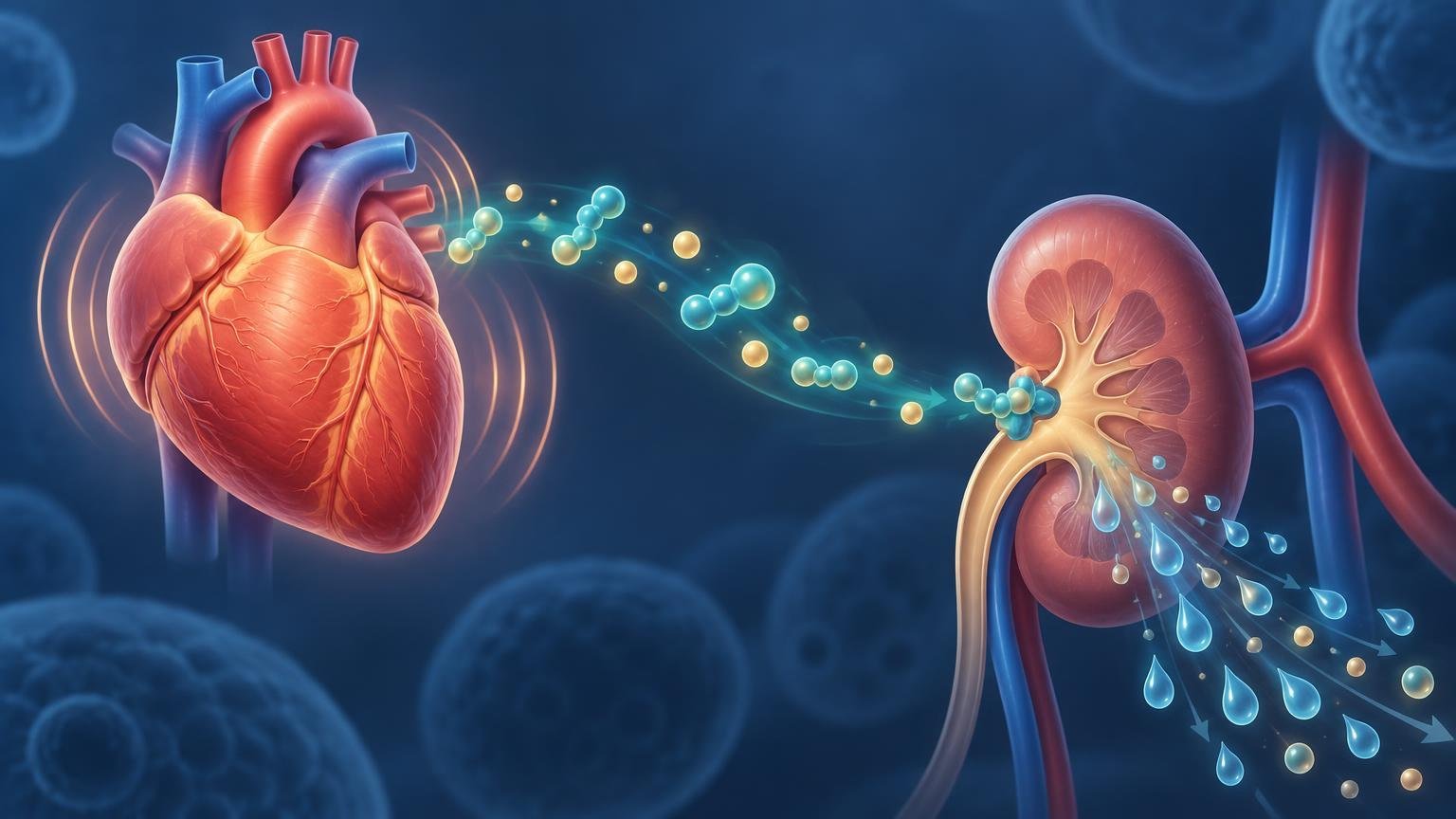
Calling BNP a hormone also highlights an important idea: the heart is an endocrine organ as well as a pump. It senses mechanical and circulatory conditions and releases chemical signals that communicate with blood vessels, kidneys, adrenal pathways, and other tissues. BNP belongs to a broader natriuretic-peptide family that helps coordinate blood pressure and fluid balance.
How cardiac stress leads to BNP signaling
The simplified pathway is cardiac wall stress, increased production and release of BNP-related molecules, receptor activation, and a fluid-regulating response. Pressure or volume-related stress can increase BNP expression and release from cardiac muscle, particularly ventricular myocardium. The concentration in blood therefore contains information about the load being experienced by the heart, although it does not reveal the cause by itself.
Active BNP binds to a receptor called natriuretic peptide receptor-A, also known as guanylyl cyclase-A. Receptor activation increases cyclic guanosine monophosphate, or cGMP, inside responsive cells. cGMP functions as a second messenger: it carries the signal from the cell-surface receptor into processes that influence vascular tone, kidney handling of sodium, and other aspects of cardiovascular regulation.
What “natriuretic” means
Natriuresis means increased excretion of sodium in urine. Because water movement is closely connected to sodium balance, natriuretic signaling also participates in the regulation of fluid volume. BNP’s established physiological actions include effects that favor blood-vessel relaxation and sodium excretion while opposing parts of the renin–angiotensin–aldosterone system, a hormonal network that can promote vasoconstriction and sodium retention.
That does not mean a BNP result directly measures total body water, blood pressure, pumping strength, or kidney output. It measures the circulating peptide. Clinicians combine that number with the rest of the cardiovascular picture.
BNP versus NT-proBNP
BNP and NT-proBNP come from processing the same precursor molecule, but they are not the same substance. During peptide processing, the precursor is divided into biologically active BNP and an inactive amino-terminal fragment called NT-proBNP. Both can be measured as biomarkers, but only BNP is the active hormone in this pair.
| Feature | BNP | NT-proBNP |
|---|---|---|
| Meaning | B-type natriuretic peptide | N-terminal pro-B-type natriuretic peptide |
| Biological role | Active signaling peptide | Inactive fragment used as a biomarker |
| Origin | Released through processing of a shared precursor | Released through processing of the same precursor |
| Test interpretation | Uses BNP-specific assay values and clinical context | Uses NT-proBNP-specific assay values and clinical context |
The numerical values from BNP and NT-proBNP tests are not interchangeable one-for-one. They have different biological handling and are measured with different assays. A threshold or trend discussed for one biomarker should not automatically be applied to the other. The 2022 AHA/ACC/HFSA heart-failure guideline discusses natriuretic peptides as part of a broader clinical evaluation rather than as isolated diagnostic answers.
Why clinicians order BNP or NT-proBNP tests
A clinician may order one of these tests when evaluating symptoms or findings that could be related to heart failure, such as unexplained breathlessness, swelling, fatigue, or exercise intolerance. These symptoms have many possible causes. Natriuretic-peptide testing can help estimate whether cardiac wall stress is part of the picture and can sometimes assist with prognosis or follow-up in established heart failure.
The test is most useful when it changes the probability of a diagnosis in combination with history, physical examination, an electrocardiogram, imaging, and other laboratory data. A result is not a direct measurement of ejection fraction, which describes how much blood a ventricle ejects during contraction. It also cannot identify the precise structural or rhythm problem responsible for increased cardiac stress.
Does a high BNP automatically mean heart failure?
No. A higher value can be consistent with increased cardiac stress, but the cause and significance depend on the clinical setting. Heart failure is one important possibility, yet kidney impairment, atrial fibrillation and other cardiovascular or systemic conditions can influence natriuretic-peptide concentrations. Age, symptoms, timing, assay selection, and treatment context can also change how a result is understood.
The reverse caution matters too: a comparatively low concentration should not be treated as an infallible exclusion in every patient. The result modifies clinical suspicion; it does not replace clinical reasoning.
Why body size, kidneys, and heart rhythm matter
Obesity is associated with lower circulating natriuretic-peptide concentrations. Researchers have proposed several contributing mechanisms, including differences in peptide production, processing, clearance, and the metabolic state of adipose tissue. Whatever the full explanation, the practical point is that obesity can complicate interpretation rather than making cardiac stress impossible.
Kidney function matters because the kidneys participate in fluid regulation and biomarker handling. Reduced kidney function can coexist with cardiovascular stress and may be associated with higher natriuretic-peptide values. Atrial fibrillation can also raise values or alter the clinical context. These factors do not make testing useless; they mean that universal, context-free cutoffs are a poor substitute for professional interpretation.
- Which test was performed: BNP or NT-proBNP
- The laboratory’s assay and reference information
- Whether symptoms are new, worsening, stable, or absent
- Kidney function and other medical conditions
- Body size and the presence of obesity
- Heart rhythm, including atrial fibrillation
- Current cardiovascular treatment and whether values are being compared over time
What BNP has to do with metabolism
BNP is primarily discussed in cardiovascular and renal physiology, but its signaling reaches beyond those systems. Natriuretic-peptide receptors are present in adipose tissue, and experimental research links natriuretic-peptide signaling with fat-cell metabolism, including pathways involved in lipolysis and energy use. This supports a broader view of the heart as an endocrine organ that communicates with metabolic tissues.
Human research has also explored whether intravenous BNP can change markers such as uncoupling protein 1, or UCP1, in adipose tissue. UCP1 is associated with heat-producing activity in thermogenic fat. A randomized crossover study examined adipose UCP1 expression after intravenous BNP, providing evidence about a biological pathway under controlled research conditions. It did not establish BNP as an effective or appropriate weight-loss treatment.
That limitation is crucial. A detectable molecular effect is not equivalent to sustained fat loss, improved metabolic health, or acceptable long-term safety. Body weight reflects energy intake, energy expenditure, fluid, glycogen, lean tissue, and fat mass. BNP can influence fluid physiology, so a short-term change on a scale would not necessarily represent a change in body fat. Mechanistic metabolic research should not be converted into consumer weight-loss claims.
BNP clearance, neprilysin, and treatment context
The body removes or degrades BNP through more than one route. These include receptor-mediated clearance and several proteolytic pathways. Neprilysin is involved in natriuretic-peptide biology, but BNP clearance should not be reduced to a single enzyme.
This becomes clinically relevant when discussing angiotensin receptor–neprilysin inhibitor therapy. Because that treatment context can affect natriuretic-peptide biology, BNP trends may require different interpretation than NT-proBNP trends. The appropriate biomarker choice and interpretation belong to the treating clinical team; patients should not change medication or monitoring based on a general explanation of the pathway.
Is BNP a medicine or consumer peptide?
Endogenous BNP, a BNP blood test, and a drug based on BNP are three distinct things. Endogenous BNP is the hormone produced in the body. A blood test measures a circulating biomarker. Nesiritide is recombinant human BNP described in FDA prescribing information, meaning it is a manufactured drug form rather than a supplement or a routine replacement for the body’s own hormone.
BNP should not be framed as a wellness peptide, dietary supplement, or do-it-yourself metabolic compound. Laboratory materials sold for research use are not equivalent to an approved medicine, and mechanistic studies do not establish safety or benefit for self-administration.
Frequently asked questions
Why is it called brain natriuretic peptide?
The name reflects the tissue in which the peptide was initially identified. In human physiology and clinical medicine, BNP is chiefly treated as a cardiac hormone, so B-type natriuretic peptide is the clearer modern term.
Can BNP diagnose heart failure on its own?
No. BNP or NT-proBNP can support or weaken clinical suspicion, but diagnosis depends on the full presentation and may require imaging and other tests. Conditions besides heart failure can affect the result, while obesity can be associated with lower concentrations.
Are BNP and NT-proBNP the same test?
No. They arise from the same precursor but measure different molecules. BNP is biologically active; NT-proBNP is an inactive fragment. Their numbers have different interpretation frameworks and should not be substituted for one another.
Does BNP burn fat?
Natriuretic-peptide signaling can affect adipose-tissue pathways under experimental conditions, but that does not show that BNP produces safe, sustained fat loss in people. It is not an established obesity treatment.
When do symptoms need prompt attention?
New or worsening shortness of breath, chest pain, fainting, confusion, rapid swelling, or severe difficulty breathing warrants timely medical assessment; severe or sudden symptoms may require emergency care. A previous BNP result should not be used to self-triage serious symptoms.
The practical takeaway
BNP is best understood as a heart-derived hormone that helps coordinate vascular tone, sodium handling, water balance, and counter-regulatory signaling. The blood test provides clinically useful information about cardiac stress, but it is not a stand-alone diagnosis and does not have one universally meaningful cutoff.
If a BNP or NT-proBNP result appears on your laboratory report, first confirm which marker was measured. Then interpret it with the symptoms, assay, kidney function, body size, heart rhythm, medications, imaging, and prior results. That context—not the number alone—is what turns a natriuretic-peptide measurement into useful clinical information.
References
- Natriuretic peptide metabolism, clearance and degradation – Potter – 2011 – The FEBS Journal – Wiley Online Library
- Cardiac natriuretic peptides | Nature Reviews Cardiology
- Biochemistry of the human B-type natriuretic peptide precursor and molecular aspects of its processing.
- 2022 AHA/ACC/HFSA Guideline for the Management of Heart Failure: A Report of the American College of Cardiology/American Heart Association Joint Committee on Clinical Practice Guidelines | Circulation
- The influence of comorbidities on achieving an N-terminal pro-b-type natriuretic peptide target: a secondary analysis of the GUIDE-IT trial – PubMed
- Diagnostic and prognostic considerations for use of natriuretic peptides in obese patients with heart failure – PubMed
- Natriuretic peptides in cardiometabolic regulation and disease | Nature Reviews Cardiology
- Human adipose tissue expression of uncoupling protein 1 in response to intravenous administration of B-type natriuretic peptide hormone: Results from a randomized controlled crossover study.
- B-Type Natriuretic Peptide (BNP) Revisited—Is BNP Still a Biomarker for Heart Failure in the Angiotensin Receptor/Neprilysin Inhibitor Era? – PMC
- label