
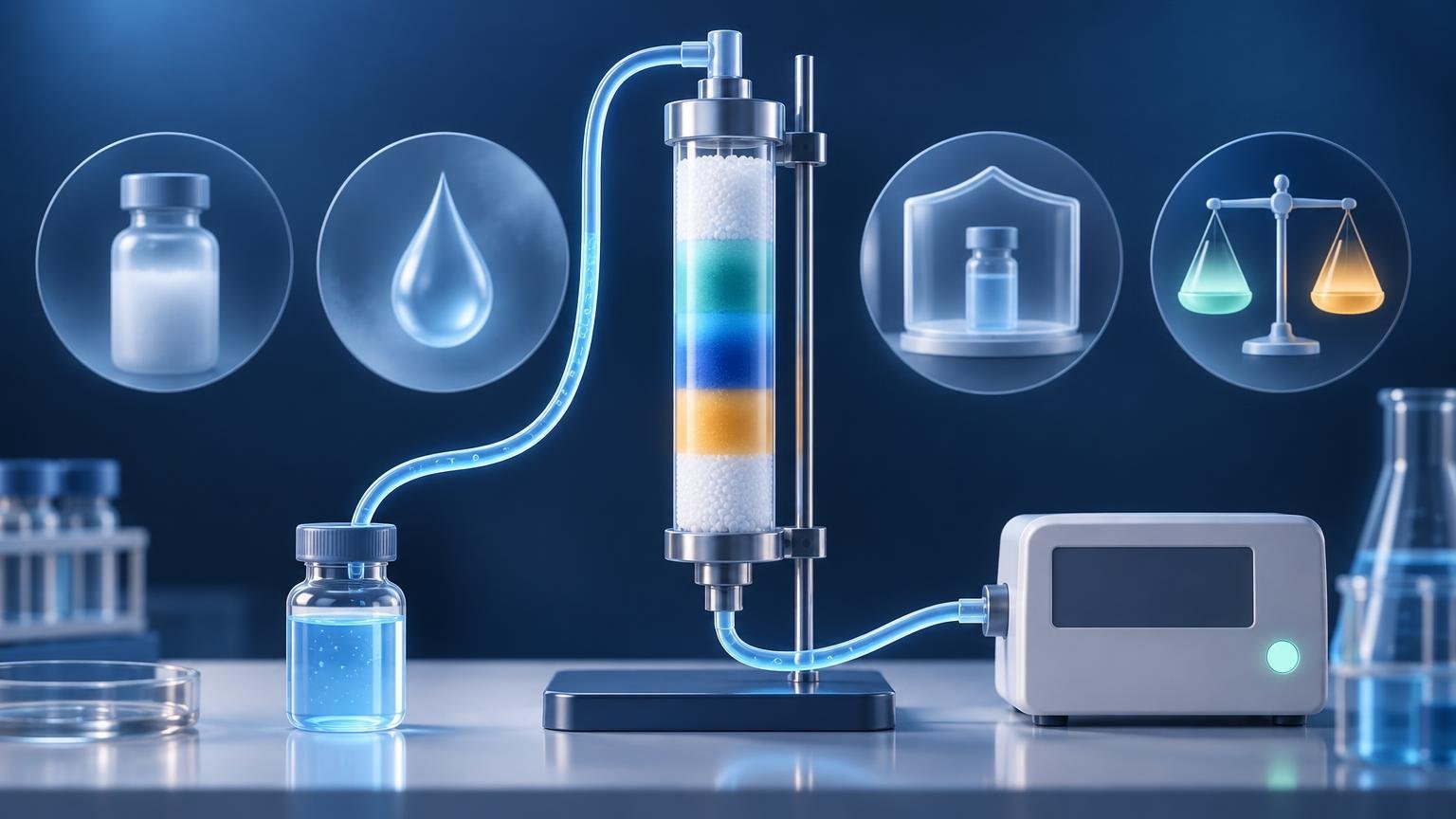
HPLC purity tells you how much of the included chromatographic detector response was assigned to the main peak under a particular test procedure. That is useful evidence about the sample’s impurity profile, but it is not a complete verdict on peptide quality.
A result such as “99% HPLC purity” does not automatically mean that 99% of the powder’s weight is the intended peptide. It also does not independently prove molecular identity, biological potency, sterility, low endotoxin, absence of residual solvents or safety in humans.
What HPLC measures
High-performance liquid chromatography, or HPLC, separates components of a sample as they travel through a column. The components ideally leave the column at different times, producing peaks as a detector records their signals.
In a relative-area calculation, the laboratory integrates the area under each included peak. The reported percentage is commonly calculated by dividing the main peak’s area by the total area of the included peaks and multiplying by 100. A 99% result therefore means that the main peak contributed approximately 99% of that included detector response—not necessarily 99% of the sample’s mass or 99% of its molecules. The ICH Q2(R2) analytical-method guideline explains why detector response and analytical procedure performance matter to quantitative interpretation.
The main peak can be strong evidence that one component dominated the signals separated and detected by that method. Minor peaks may represent synthesis-related impurities, degradation products or other detectable components, but the chromatogram does not automatically identify what every peak contains.
Why the percentage depends on the method
Two laboratories could therefore obtain different area percentages from the same material if their methods differ. Even within one chromatogram, a poorly resolved impurity may overlap the main peak, while a component with little or no response at the selected detector setting may contribute little to the calculation. A percentage is most informative when the certificate provides enough method detail to show how it was produced.
Purity and identity answer different questions
Chromatographic purity asks, “How dominant was the assigned main peak relative to the other included peaks?” Identity asks, “Is this peak actually the intended peptide?” Those questions overlap, but they are not interchangeable.
Retention time can support identity when a sample is compared with an appropriate reference standard, but a retention-time match alone is not always sufficiently specific. Mass spectrometry can add evidence about molecular mass, while other orthogonal methods can test different structural features. Synthetic peptides can present difficult structural or stereochemical impurities, so no single analytical signal necessarily settles every identity question.
The same principle applies to identifiers printed on documentation. A peptide CAS number identifies a registered substance, but it does not prove that the tested material has the claimed sequence, identity or purity.
HPLC purity is not peptide content
Peptide content or assay addresses how much peptide is present in a stated quantity of material. Chromatographic purity compares detector signals within the chromatogram. These measurements can produce different percentages because the physical material may also contain water, salts, counterions, residual solvents or other substances that are not represented proportionally in an HPLC area calculation.
For example, a powder could produce a chromatogram in which the main peptide peak accounts for 99% of the included peak area while the powder itself contains appreciable water or counterion mass. The chromatographic result may still be accurate for its stated calculation, but it does not establish how many milligrams of peptide are present in the vial.
Quantitative characterization may require complementary approaches. Published work on synthetic peptide reference standards describes combinations of HPLC, mass spectrometry, amino-acid analysis, nuclear magnetic resonance, gas chromatography and mass-balance methods. The appropriate combination depends on the peptide and the measurement question. Research on synthetic peptide reference standards discusses this complementary approach, while amino-acid analysis is one established option for peptide quantitation when the peptide and hydrolysis method are suitable.
The quality questions HPLC purity cannot answer alone
| Quality question | What it means | Why HPLC purity is insufficient |
|---|---|---|
| Identity | Whether the material is the intended peptide | A dominant peak or retention-time match is not necessarily a specific structural identification. |
| Peptide content or strength | How much peptide is present in a stated amount of material | Peak-area percentage is detector response, not automatically peptide mass. |
| Water | How much water the material contains | Water requires a separate measurement, such as an appropriate Karl Fischer procedure. |
| Residual solvents | Whether volatile manufacturing solvents remain and at what levels | Residual solvents have their own risk-based limits and analytical procedures. |
| Sterility | Whether viable contaminating microorganisms are absent under the specified test | A chemical chromatogram is not a sterility test. |
| Endotoxin or pyrogens | Whether fever-producing contamination meets applicable limits | Dedicated bacterial endotoxin or pyrogen methods are required. |
| Biological potency | Whether the material produces a defined biological effect at a stated strength | Chemical peak area does not directly measure receptor activity or another biological response. |
| Clinical safety | Whether a product is acceptably safe for a particular human use | Safety depends on far more than chromatographic purity, including formulation, route, exposure, manufacturing controls and clinical evidence. |
Water and residual solvents
Water content is a separate quality attribute. FDA and ICH specifications guidance identifies Karl Fischer titration as a water-specific method that may be preferable to loss on drying in appropriate circumstances. Residual solvents are also evaluated separately under the ICH risk-based framework for volatile organic chemicals remaining from manufacturing or purification.
Sterility and endotoxin
A clean-looking chromatogram cannot establish sterility. Products required to be sterile need a dedicated sterility procedure and acceptance criterion.
Sterility and endotoxin are themselves different questions. A test for viable microorganisms does not replace testing for bacterial endotoxins or other pyrogen concerns. The FDA’s pyrogen and endotoxin testing guidance describes dedicated methods and criteria for this purpose.
Potency and clinical safety
Potency can refer to biological activity, while assay or strength can refer to the amount of an active substance. Neither is automatically established by the relative area of an HPLC peak. A peptide could have a dominant chromatographic peak yet still require separate quantitative and functional evidence for its intended application.
Clinical safety is broader still. It depends on identity, strength, purity, formulation, microbiological and particulate controls, stability, route of administration, exposure, manufacturing consistency, nonclinical findings and human clinical evidence. FDA’s chemistry, manufacturing and control guidance for clinical investigations treats identity, strength, quality and purity as related but distinct parts of product characterization.
How to read an HPLC result on a peptide certificate
The percentage should be the beginning of the interpretation, not the end. A useful certificate of analysis makes it possible to connect the result to a particular sample and understand the basis of the calculation.
- Confirm that the certificate names a specific lot or batch rather than presenting a generic example.
- Check the sample identification and test date.
- Look for the chromatogram and peak table, not only a headline percentage.
- Determine whether the result is area percent, corrected area percent or another calculation.
- Review the stated HPLC method, detector setting and integration approach where provided.
- Look for separate identity evidence, such as appropriately interpreted mass-spectrometry data.
- Check whether peptide content or assay was measured separately from chromatographic purity.
- For the intended research context, identify whether separate water, residual-solvent, counterion, microbiological, endotoxin, particulate or stability results are relevant.
Lot matching matters because analytical data from one batch do not automatically characterize another. Celtek’s peptide testing and certificate explanation, for example, describes lot-specific documentation and explicitly distinguishes chromatographic purity from peptide content, sterility, endotoxin status, residual solvents and suitability for injection. Its materials are described as research use only, not for human or veterinary use.
The right conclusion from a high HPLC purity result
A high HPLC area percentage supports a narrow and useful conclusion: under the stated method, the assigned main peak dominated the included chromatographic response. Confidence in that conclusion improves when the method is suitable, peaks are adequately resolved, integration is transparent and the result is tied to the correct lot.
The result becomes much more informative when paired with orthogonal identity testing and separate measurements for content and other relevant quality attributes. On its own, however, “99% HPLC purity” is not shorthand for “99% peptide,” “pharmaceutical grade,” “sterile,” “potent” or “safe.” It is one analytical result answering one defined question.
References
- ICH Q2(R2) Guideline
- Characterization of Synthetic Peptide Therapeutics Using Liquid Chromatography-Mass Spectrometry: Challenges, Solutions, Pitfalls, and Future Perspectives
- Q6A Specifications: Test Procedures and Acceptance Criteria for New Drug Substances and New Drug Products: Chemical Substances | FDA
- Reference Standards to Support Quality of Synthetic Peptide Therapeutics
- Analysis of Peptides and Conjugates by Amino Acid Analysis.
- INTERNATIONAL COUNCIL FOR HARMONISATION OF TECHNICAL REQUIREMENTS FOR
- Pyrogen and Endotoxins Testing: Questions and Answers | FDA
- IND Applications for Clinical Investigations: Chemistry, Manufacturing, and Control (CMC) Information | FDA
- Peptide Testing & Certificates of Analysis – celtek-peptides.com