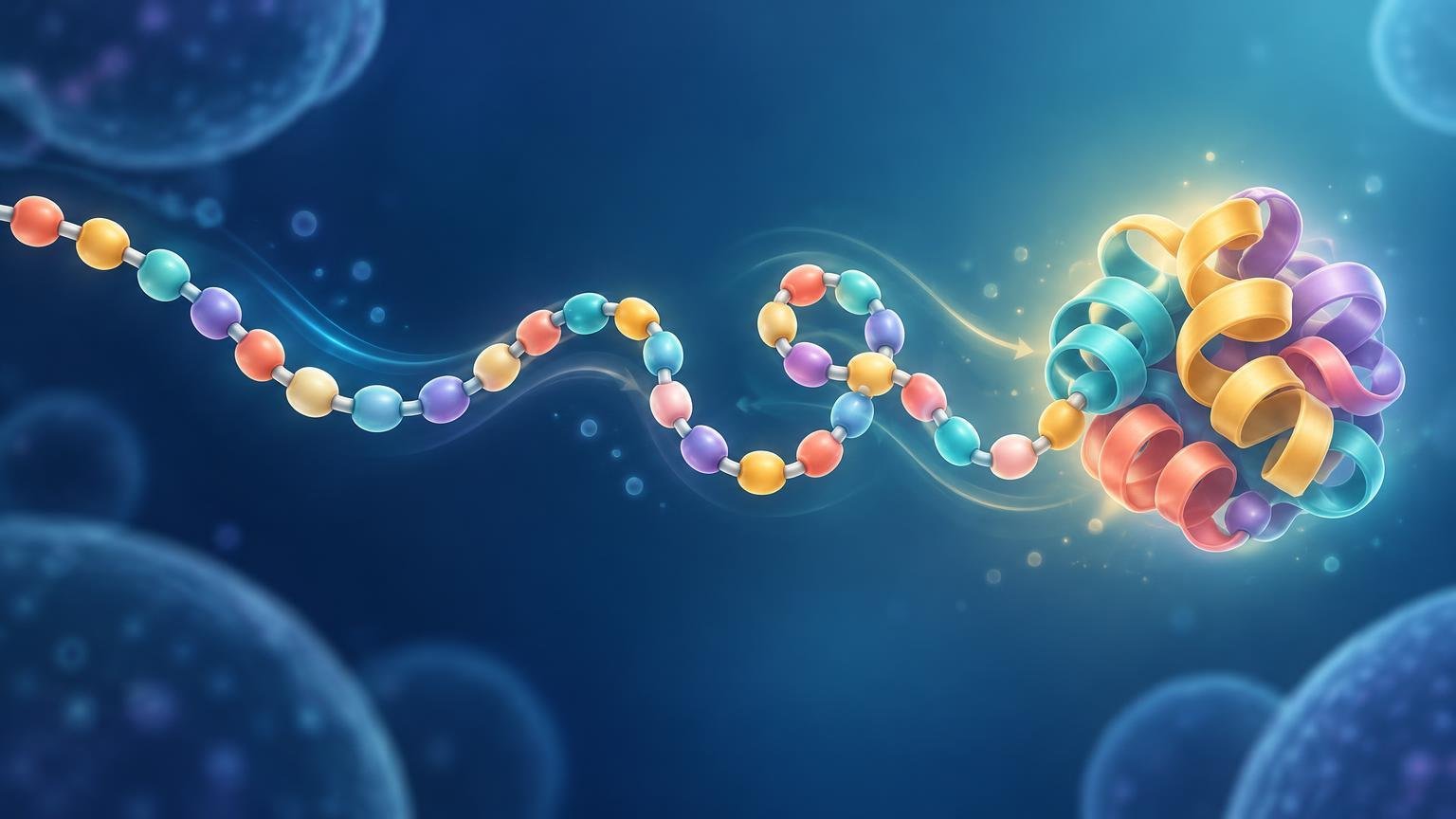
If you are asking what is a polypeptide, the direct answer is: a polypeptide is a chain of amino acids joined by chemical links called peptide bonds. Each chain has a specific amino-acid sequence and two chemically distinct ends, known as the amino or N-terminus and the carboxyl or C-terminus.
That definition describes how the molecule is built, not what it does. One polypeptide may become an enzyme, another may contribute to a structural protein, and another may act as a signaling molecule after it is folded and processed. Some chains do not function on their own at all. Their effects depend on their sequence, three-dimensional shape, chemical modifications, location, and interactions with other molecules.
What is a polypeptide made of?
Amino acids are the building blocks of polypeptides. Although amino acids differ in their side chains, they share a basic chemical framework that allows one amino acid to connect to the next. When the carboxyl group of one amino acid reacts with the amino group of another, a covalent peptide bond forms.
Once an amino acid has been incorporated into a chain, biochemists often call it an amino-acid residue. A chain can therefore be described as a sequence of residues connected through peptide bonds. One end retains a free amino group and is called the N-terminus; the other retains a free carboxyl group and is called the C-terminus. Scientific sequences are conventionally written from the N-terminus toward the C-terminus.
The order of those residues is the polypeptide’s primary structure. This is not merely a label or catalog number. The sequence determines where hydrophobic, charged, flexible, or chemically reactive regions occur, which strongly influences how the chain folds and what it can interact with. The NCBI Bookshelf overview of the chemical components of cells provides a deeper introduction to this relationship between amino-acid sequence and protein structure.
Peptide, polypeptide, and protein are related but not identical
The terms peptide, polypeptide, and protein overlap, which is why simple definitions based entirely on length often cause confusion. A peptide is an amino-acid chain, and polypeptide generally refers to a longer chain. A protein is a functional biological molecule made from one or more folded polypeptide chains, often with additional chemical modifications or non-protein components.
There is no single amino-acid count that serves as a universal boundary between a peptide and a polypeptide. Different scientific fields and reference systems use somewhat different conventions. Chain length can be a useful clue, but it should not be treated as a law of nature.
| Term | Practical meaning | Important limitation |
|---|---|---|
| Peptide | An amino-acid chain, often relatively short | The maximum length varies by source and context |
| Polypeptide | A chain of many amino-acid residues joined by peptide bonds | The term describes chain structure, not necessarily biological function |
| Protein | A functional biological molecule containing one or more folded polypeptide chains | Some proteins require multiple chains, chemical modifications, or other components |
A single polypeptide can form an entire functional protein after folding and processing. In other cases, several polypeptide chains must assemble into a larger complex. Conversely, a newly produced or incorrectly folded polypeptide is not automatically a functional protein.
This distinction is especially useful when evaluating claims about “peptides” in nutrition, medicine, or research. Classifying something as a peptide or polypeptide reveals part of its chemistry, but it does not tell you its receptor target, potency, stability, safety, or physiological effect.
How cells make polypeptides
Cells build polypeptides through translation. DNA contains genetic information, but ribosomes do not generally read DNA directly. Instead, a gene’s information is copied into messenger RNA, or mRNA. A ribosome moves along the mRNA and reads its nucleotide sequence in three-letter units called codons.
Transfer RNA molecules bring the corresponding amino acids to the ribosome. The ribosome helps form peptide bonds as each new amino acid is added to the growing chain. Because residues are added at the C-terminal end, the polypeptide is synthesized from its N-terminus toward its C-terminus.
Translation is only the beginning for many proteins. A newly synthesized chain may need to fold, have sections removed, acquire chemical groups, move to a particular part of the cell, or associate with other chains. These later steps help explain why knowing a gene sequence or amino-acid sequence does not, by itself, reveal every feature of the mature protein.
Why sequence and shape determine function
Two polypeptides containing the same number of amino acids can behave very differently if their sequences differ. The order of residues changes how sections of the chain attract or repel water, form internal bonds, and interact with surrounding molecules.
As a chain folds, local patterns can form recurring structures such as helices and sheets. Longer-range interactions then help produce an overall three-dimensional shape. If several chains assemble, their arrangement adds another level of structure. Biochemists commonly describe these levels as primary, secondary, tertiary, and quaternary structure.
Shape matters because biological interactions are selective. An enzyme needs an appropriate active site to bind and transform its substrates. A receptor-binding polypeptide needs structural and chemical features that fit its target. A structural protein needs an architecture suited to bearing force or organizing tissue. These functions cannot be inferred from the word “polypeptide” alone.
Folding is also not guaranteed to be permanent. Temperature, acidity, chemical conditions, mutations, and cellular quality-control systems can influence whether a chain maintains the shape associated with normal function. A change in shape may reduce activity, expose new interaction surfaces, or lead the cell to degrade the molecule.
What happens to polypeptides in food?
Dietary proteins are polypeptide-based molecules, but eating a protein is not the same as delivering its original intact chains directly to tissues. Digestion begins breaking proteins into smaller fragments. Enzymes in the stomach and small intestine produce shorter peptides and free amino acids, while enzymes at the intestinal surface continue the process.
The small intestine can absorb free amino acids as well as some dipeptides and tripeptides, which contain two or three amino-acid residues. Absorbed small peptides are generally broken down further within intestinal cells before their amino acids enter circulation.
This process serves metabolism by making amino acids available for new protein synthesis and other biochemical pathways. The body can use those amino acids to build its own polypeptides according to cellular instructions. It does not simply route every dietary chain, unchanged, into the same role that chain performed in the original food.
That difference is important when interpreting claims that a food-derived peptide must reproduce the effects of a hormone or medicine. Digestion, absorption, stability, tissue exposure, and receptor binding all stand between a molecular sequence and a whole-body effect. A nutritional protein can still affect fullness, amino-acid availability, and other metabolic processes, but those questions require evidence beyond its classification as a polypeptide.
How polypeptides participate in metabolic signaling
Some hormones are peptides or polypeptides. These signaling molecules allow tissues to communicate about processes such as nutrient availability, glucose regulation, appetite, digestion, fluid balance, growth, and stress responses. But not every polypeptide is a hormone, and not every hormone is a polypeptide.
Peptide hormones are commonly produced as larger precursor proteins. Cells process these precursors by cutting the chain at selected locations and making other modifications, releasing a biologically active signaling molecule. This is another reason chain length alone provides an incomplete description: a precursor and its final active product can have different structures and roles.
A hormone’s metabolic effect comes from its particular sequence and structure, the receptors it activates, where those receptors are expressed, and how long the signal persists. For example, B-type natriuretic peptide is a specific heart-derived signaling hormone involved in fluid and vascular regulation. It should not be generalized to represent what all peptides or polypeptides do.
Polypeptide medicines are molecule-specific
Some medicines are peptides or polypeptides designed to reproduce, modify, or extend a biological signal. Others replace a molecule the body does not produce adequately. Calling a medicine a peptide describes its molecular class, but it does not establish its approved use, effectiveness, dosing, or safety.
Clinical pharmacology must consider how each product is absorbed or otherwise reaches circulation, how it is distributed and eliminated, how exposure relates to its effects, and whether it can provoke an unwanted immune response. FDA draft guidance therefore describes product-specific evaluation of pharmacokinetics, efficacy, safety, and immunogenicity for peptide drug products. FDA’s peptide drug clinical pharmacology guidance discusses these considerations in regulatory context.
Chemical engineering can also make a therapeutic peptide behave differently from the natural hormone on which it was modeled. Changes may alter receptor activity, resistance to enzymatic breakdown, or time in circulation. Semaglutide’s peptide structure, for example, is only the starting point for understanding its pharmacology; its specific modifications and clinical evidence matter far more than the peptide label by itself.
Dietary peptides, endogenous hormones, investigational compounds, and approved medicines should therefore remain separate categories. They may all contain peptide bonds, but they encounter different biological conditions and carry very different levels of evidence. One cannot responsibly transfer an effect or safety conclusion from one category to another merely because the molecules are all called peptides.
A practical way to interpret the term
When you encounter the word polypeptide, start with the structural meaning and then ask questions that reveal its biological context:
- What is the exact amino-acid sequence?
- Has the chain been folded or chemically modified?
- Does it act alone, or is it one subunit of a larger protein?
- Is it a dietary fragment, a naturally produced signaling molecule, a research compound, or a medicine?
- What receptor, enzyme, or other target does it interact with?
- What type of evidence supports the claimed effect: biochemical experiments, animal research, human trials, or approved-use data?
These questions prevent a common reasoning error: treating a broad molecular category as though it predicts one health outcome. “Polypeptide” is comparable to a construction description. It tells you that amino-acid residues have been linked into a chain. To understand function, you still need to know the chain’s sequence, final shape, processing, location, exposure, and biological target.
The central takeaway
A polypeptide is a chain of amino acids connected by peptide bonds. Its amino-acid order forms its primary structure, while folding, processing, chemical modification, and assembly determine whether it becomes part or all of a functional protein.
The boundaries among peptide, polypeptide, and protein are not defined by one universally accepted length cutoff. More importantly, the term does not predict a specific metabolic or medical effect. Food proteins, natural peptide hormones, and peptide medicines may share the same basic bond chemistry, but their roles depend on the identity and biological context of each molecule.
Frequently Asked Questions
Is every polypeptide a protein?
No. A polypeptide may become all or part of a functional protein after folding, processing, or assembly with other chains. Some polypeptides do not function independently.
How many amino acids are in a polypeptide?
There is no universally accepted length cutoff separating a peptide from a polypeptide. The terminology varies by source and scientific context.
How do cells make polypeptides?
During translation, a ribosome reads codons in messenger RNA while transfer RNAs supply amino acids. The ribosome helps link those amino acids into a growing chain through peptide bonds.
Are dietary polypeptides absorbed intact?
Dietary proteins are generally digested into smaller peptides and free amino acids. The small intestine can absorb amino acids, dipeptides, and tripeptides, with absorbed small peptides generally broken down further inside intestinal cells.
Are all polypeptides hormones?
No. Some hormones are peptides or polypeptides produced from larger precursor proteins, but polypeptides can also serve many non-hormonal roles.
References
- The Chemical Components of a Cell – Molecular Biology of the Cell – NCBI Bookshelf
- From RNA to Protein – Molecular Biology of the Cell – NCBI Bookshelf
- Peptides – MeSH – NCBI
- Physiology, Nutrient Absorption – StatPearls – NCBI Bookshelf
- Understanding peptide hormones: from precursor proteins to bioactive molecules – PMC
- Clinical Pharmacology Considerations for Peptide Drug Products | FDA